If you've spent any time on a steel plant floor or in its operations office, you already know, this industry doesn't run on guesswork.
You're dealing with enormous quantities of raw materials, dozens of product grades, fluctuating order volumes, and clients who expect precision.
One wrong move in inventory, say, running out of a specific coil grade mid-production, and you're looking at costly delays, angry customers, and a serious dent in your margins.
That's exactly why more steel manufacturers are turning to Manufacturing ERP Software.
Not because it's trendy, but because it genuinely solves the messy, expensive, day-to-day inventory problems that spreadsheets and disconnected systems simply can't.
In this blog, we'll walk through why inventory management is so uniquely complicated in the steel industry, what Manufacturing ERP software does, and how its helping steel businesses run leaner, smarter, and more profitably.
What Makes Inventory Management in the Steel Industry So Complicated?
Steel isn't one thing. Even within a single product family, cold-rolled flat products, say, you might have 30 or 40 variants based on grade, thickness, width, and coating. From a materials management standpoint, these are entirely different items.
Mixing them up causes production failures, failed inspections, and customer disputes.
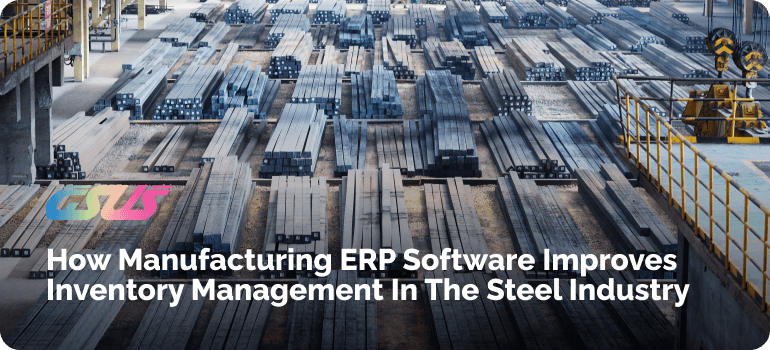
Layered on top of that: the physical reality. Thousands of tons of material spread across covered bays, open yards, and in-process areas.
Demand spikes and dips with infrastructure projects and construction cycles. Customers, particularly in structural and industrial applications, require full traceability from the raw material all the way to delivery.
The core problems that keep surfacing are stock figures that don't reflect what's on the floor, no early warning when material is running low, procurement that's reactive rather than planned, and audit trails that exist on paper files nobody can find quickly.
These compound each other, and the result is unnecessary cost, production delays, and damaged customer relationships.
Key Features of Manufacturing ERP That Actually Matter for Steel
Is Your Inventory Data Actually Current?
Real-time stock tracking is the most immediate win. In simple terms, each outstanding receives, transports, creates consumption, and the shipment updates the scheme immediately, not at the end of the level, not in a batch of loading.
Whether you have two storage locations or ten, you know exactly what's on hand, at which location, right now. That alone eliminates most of the daily back-and-forth between warehouse staff, planners, and sales.
Can You Trace Every Ton Back to Its Source?
Heat number and batch tracking is where ERP Software for Manufacturing really earns its place in steel.
When material arrives, you record the heat number, mill certificate reference, and any specification data relevant to your customers or quality system.
That heat number follows the material wherever it goes, into production, to a customer, between locations. If a quality issue surfaces months later, you produce a complete audit trail in minutes.
This level of traceability is increasingly a baseline customer expectation in structural, pressure vessel, and industrial applications.
Are You Still Manually Raising Purchase Requests?
Automated replenishment is straightforward but genuinely valuable. You set minimum stock levels, and the ERP raises a purchase request automatically when stock dips below that threshold.
Pair that with demand forecasting, the system analysing open orders, production schedules, and historical usage to project future needs, and procurement shifts from reactive scrambling to proactive planning.
For steel businesses carrying high-value inventory, even modest reductions in average stock holding have a real working capital impact.
Do You Know Exactly Where Every Item Is Stored?
Warehouse management within Manufacturing ERP Software assigns defined bin or bay locations to each stock item. Incoming material gets directed to a specific location. Picking for production or dispatch pulls from a confirmed location.
You stop relying on whoever happens to know the best yard. Large facilities with open-yard storage, where material genuinely gets lost for weeks, benefit especially from this.
How Does Manufacturing ERP Actually Improve Operations in a Steel Plant?
Full Visibility Across Every Department
When procurement, production, and finance are all looking at the same data, you stop playing on the telephone. Your production planner knows exactly what's in stock.
Your procurement team knows what's already on order. Your finance team gets auto-updated inventory valuations without chasing warehouse supervisors for reports.
This unified data setting is particularly potent for metal enterprises managing several fabrication workflows or having distinct departments for various commodity groups.
Cutting Down on Inventory Costs
Excess inventory in steel isn't just a storage problem; it's a capital problem. Heavy materials occupy expensive floor space, and slow-moving stock quietly erodes your margins.
A well-configured Manufacturing ERP helps you right-size your inventory by flagging slow movers, ageing stock, and material that hasn't been touched in months.
On the flip side, it also prevents the cost of stockouts, emergency procurement, production stoppages, and customer penalties. The sweet spot between too much and too little is where ERP software earns its keep.
Better Production Planning, Less Scrambling
Nothing disrupts a production schedule quite like discovering mid-shift that requires material isn't available. Manufacturing ERP software links your production orders directly to inventory status.
Basically, before confirming a project, the scheme checks that the necessary materials are available. If not, it raises a flag early, giving procurement time to act without the drama.
Traceability That Holds Up Under Audit
ISO certifications, customer audits, regulatory compliance, and steel manufacturers face a gauntlet of documentation requirements.
A proper ERP system maintains a complete audit trail: who received what, when, which batch went into which order, and what quality documentation accompanied it. When an auditor walks in, you're not scrambling to reconstruct paper trails.
Faster, Smarter Decision-Making
Dashboards and reports in a Manufacturing ERP surface the information you need, stock turn ratios, supplier lead times, production yield rates, inventory ageing, without anyone having to compile it manually. Managers can spot problems early and respond with data, not gut feel.
What Does the Before-and-After Actually Look Like?
A structural steel fabricator processing around 7,000 tons per month. Pre-ERP: inventory in Excel, updated end of day. Stock discrepancies every week. Production planners start shifts without confirmed material.
Customer deliveries were delayed because material had been consumed by another job without reservation; nobody knew until it was too late.
After implementing a Manufacturing ERP system: real-time visibility meant planners could confirm availability before accepting orders. Heat tracking cut customer quality disputes sharply.
Automated reorder points meant stockouts became rare. Inventory holding costs dropped in the first year, and delivery accuracy improved meaningfully.
That's not an exceptional outcome. It's what happens when the tools match the actual complexity of the operation.
GSUS is an Odoo Silver Partner with hands-on experience implementing Odoo's Manufacturing ERP in steel and heavy manufacturing businesses. Odoo's inventory, production, procurement, and quality modules work together natively, and they're flexible enough for steel specific demands. If you're evaluating options, the GSUS team can walk you through a working demo tailored to your operations. Get in touch.
Key Benefits briefly
- Prevented stockouts via automated restocking and needs-based forecasting
- Significantly boosted inventory precision through live monitoring across all storage sites
- Reduced holding expenses by cutting surplus inventory and pinpointing stagnant items
- Complete material visibility from arrival through manufacturing to client handoff
- Expedited, more dependable order processing and enhanced client contentment
- Compliance-ready records for quality certifications and regulatory adherence
- Evidence-based operational summaries without tedious manual spreadsheet work
How Do You Choose the Right Manufacturing ERP for a Steel Business?
Not every ERP vendor understands steel. Some platforms are built for discrete, assembly-line manufacturing, and struggle with batch-and-weight complexity. Key things to evaluate:
- Steel-specific functionality: native heat number management, multi-unit-of-measure support (tons, pieces, metres, coils), and built-in batch traceability, not bolted-on workarounds
- Scalability: the system should grow with you, new product lines, additional locations, higher volumes, without a painful reimplementation
- Integration: weighbridges, production equipment, customer portals, the more it connects with your existing infrastructure, the more value you get
- Partner experience: a vendor or partner who has implemented ERP specifically in steel or metals will save you months of configuration pain
Odoo's Manufacturing ERP is worth serious consideration for mid-sized steel businesses. It's modular, well-integrated, and handles steel's operational requirements well. As an Odoo Silver Partner, GSUS has guided steel and metals businesses through the full journey, from scoping and configuration to go-live and ongoing support.
Where Is Manufacturing ERP Headed? Future Trends Worth Watching
The ERP landscape is evolving quickly, and some of the coming changes will be especially relevant for steel manufacturers:
AI-Driven Forecasting
Newer ERP systems are starting to factor in external signals, commodity prices, infrastructure project pipelines, logistics lead times, alongside internal data. For steel, where demand tracks macro-level project activity closely, that kind of intelligence has real practical value.
IoT in the Yard
Connected sensors on storage racks and handling equipment can feed real-time location data directly into the ERP, closing the gap between physical reality and system records. For open-yard steel storage, IoT integration is a meaningful shift.
Cloud ERP
Cloud-based Manufacturing ERP has matured enough to be a credible option for mid-to-large manufacturers, lower infrastructure overhead, easier remote access, faster updates. Odoo's cloud platform is a strong example. GSUS can help you assess whether it's the right fit for your setup.
Conclusion
If you're still relying on spreadsheets, disconnected systems, or basic accounting software to manage your inventory, the honest answer is you're leaving money on the table every single month.
Manufacturing ERP software doesn't just organise your stock. It connects your entire operation, procurement, production, warehouse, and finance, into a single source of truth that lets every part of the business move faster and smarter.
The steel industry is competitive enough without fighting your own systems. If you're ready to evaluate what a proper ERP Implementation could look like for your operation, GSUS is a great place to start, an Odoo Silver Partner with hands-on manufacturing experience and a track record of implementations that stick.
The question isn't really whether your business needs ERP. It's how much longer you can afford to operate without it.