There is a moment every quality manager has lived through. A batch comes off the line; the inspection team flags something, and suddenly the whole floor stops.
Rework orders go out. Someone starts pulling records. The customer gets a difficult phone call.
It is frustrating, not just because of the cost, but because deep down, most people in that room had a nagging feeling the problem was coming. The machine had been running a little rough. A new material batch came in last week.
Something fell slightly off on Tuesday. But without the right systems, those instincts stay instincts. They never become action.
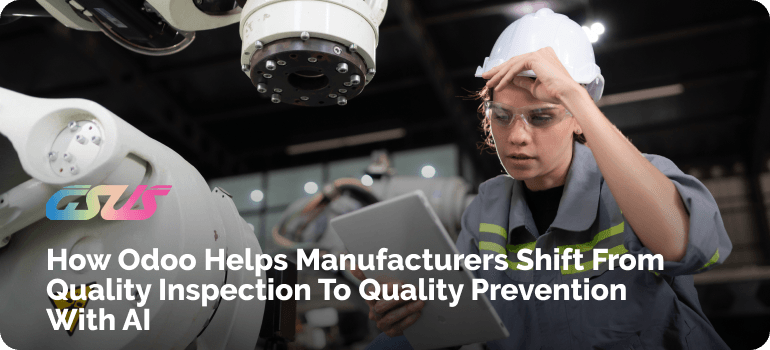
That gap, between sensing a problem and being able to do something about it before it happens, is exactly what modern Odoo Quality Management and AI are starting to close.
This blog is about what that looks like, and why manufacturers who make the shift are starting to pull ahead of those who haven't.
Why Is Traditional Quality Inspection Losing Ground?
The core problem with conventional quality control is that it's reactive by design. You inspect what's already been made.
By the time an issue surfaces, a dimensional defect, a surface flaw, a batch of contamination, you've already consumed materials, machine time, and labor. The damage is done.
Common pain points manufacturers tell us about repeatedly include:
- Human inspectors catching issues inconsistently, especially under time pressure or fatigue
- Defects discovered late in the production cycle, when correction costs are at their highest
- No clear visibility into why a quality problem keeps recurring
- Mounting rework and scrap costs that quietly erode margins
- Rising customer expectations around defect-free delivery and full traceability
These aren't small inconveniences. For mid-to-large manufacturers, poor quality control in manufacturing can mean thousands of rework costs per week, supplier disputes, delayed shipments, and damaged customer relationships that take years to repair.
Why Has Traditional Quality Inspection Stopped Being Good Enough?
For most manufacturing history, quality control meant inspecting finished goods and pulling out the bad ones.
And for a long time, that was fine. Volumes were lower, customers had fewer options, and the cost of imperfection was easier to absorb.
None of those things are true anymore.
Today's manufacturers are dealing with tighter delivery windows, more demanding customers, higher material costs, and global competition that makes every percentage point of yield matter.
In that environment, a reactive quality model creates problems that compound fast:
- By the time a defect shows up in final inspection, you've already spent the labor, machine time, and material to produce it. The waste is baked in.
- Human inspectors, however skilled, are inconsistent. Fatigue, shift changes, production pressure, all of it creates variation in what gets caught and what doesn't.
- When issues are found late, the investigation that follows is expensive. You're piecing together what happened days or weeks after the fact, with incomplete data.
- Root causes stay hidden longer than they should, which means the same problem quietly repeats across multiple batches before anyone connects the dots.
Quality control in manufacturing has always been important. The question now is whether it's designed to catch problems or prevent them. Those are very different things.
What Does Preventive Quality Management Actually Mean on the Shop Floor?
The phrase "preventive quality" gets thrown around a lot. But in practice, it comes to one idea: you monitor what's happening during production, not just what came out of it.
Instead of a quality check at the end of a work order, you have check points embedded throughout the process, after setup, mid-run, before handoff to the next stage.
Instead of investigating a failure after it's occurred, you're watching early signals that a process is drifting out of tolerance. When something looks wrong, you act before a single defective unit is produced.
The manufacturers who've moved in this direction report outcomes that are hard to argue with:
- Scrap rates dropping by 20 to 40 percent in the first year of implementation
- Rework labor hours falling sharply because fewer products need correction
- Faster production cycles because quality issues don't stop lines mid-run
- Cleaner compliance documentation because quality data is captured automatically
- Better supplier relationships because incoming material quality is tracked and visible
Prevention isn't just a quality strategy. It's a cost strategy, an efficiency strategy, and increasingly, a customer retention strategy.
How Does AI Change the Game for Quality Control in Manufacturing?
AI gets overhyped in most manufacturing conversations. Let's be specific about what it actually contributes to quality management, and what it needs to work well.
The honest version of AI in manufacturing quality looks like this:
Predictive analytics for process monitoring:
AI models trained on historical production data can recognize the conditions that precede a quality failure.
A combination of machine temperature trends, cycle time drift, and incoming material variation that, individually, looks unremarkable, but together signals a problem coming. Catching that pattern three hours early changes the outcome entirely.
Root cause analysis that used to take days:
AI can cross-reference variables across hundreds of production runs in seconds. When a defect cluster appears, it can surface correlations a human analyst would spend a week chasing. That speed matters enormously when you're trying to stop a problem from affecting the next batch.
Automated alerts that go to the right people:
Not a general alarm, but a targeted notification to the process engineer, with context: what's deviating, by how much, and what's worked in the past. That's the difference between noise and actionable intelligence.
What AI needs to do with any of these is clean, structured, and centralized data. That's not a small thing. A lot of manufacturers have data; it's just scattered across spreadsheets, standalone machines, paper records, and disconnected systems.
Before AI adds value, that data problem must be solved. Which is why the platform underneath matters so much.
How Does Odoo Quality Management Support Preventive Quality Strategies?
Odoo's Quality module isn't marketed loudly, but manufacturers who've implemented it properly, it tends to become one of the most-used parts of the system. Here's what it does that matters:
Quality control points embedded in manufacturing workflows - you define checkpoints at specific stages of a work order, and Odoo enforces them.
A product can't move forward until the check is completed and logged. No more relying on someone remembering to do an inspection.
Quality alerts with structured corrective action workflows - When a check fails, Odoo quality control doesn't just flag it.
It triggers an alert, assigns it to the right person, tracks the corrective action through to closure, and keeps a full audit trail. That's the kind of process discipline that ISO audits and customer quality reviews are looking for.
Traceability that works - Odoo Manufacturing connects quality records to lot numbers, serial numbers, supplier purchase orders, and specific work orders.
If a quality issue surfaces, today or six months from now, you can trace it back through the entire production and supply chain history in minutes.
The data foundation for AI adoption - because Odoo integrates quality, production, inventory, and procurement in one system, the data it generates is structured and connected.
That's the prerequisite for AI tools to deliver meaningful predictions. Without it, you're building on sand. The practical value of Odoo Quality Management is that it brings discipline to quality processes while simultaneously creating the data infrastructure that makes smarter analysis possible down the line.
How Does GSUS Help Manufacturers Build Smarter Quality Systems?
We've worked with manufacturers who came to us after a previous Odoo Implementation that didn't deliver. The software was there. The license was paid.
The quality module was technically active. But quality checks weren't embedded in the right production steps; alert workflows weren't configured for their actual processes, and the data coming in was inconsistent enough to be unreliable.
Technology wasn't a problem. The implementation was.
As an Odoo Silver Partner, GSUS focuses specifically on manufacturers, not generic ERP deployments.
When we implement Odoo Quality Management for a manufacturing client, the work is largely about process design before it's software configuration.
What are the actual failure modes in this facility? Where in the production flow do early signals appear? Who needs to be notified when something deviates? What does a corrective action process look like for this team?
The implementation work we do covers:
- Manufacturing workflow analysis and quality checkpoint design
- Odoo configuration aligned to how the facility runs, not a generic template
- Integration with AI and analytics tools where clients are ready for that next step
- Training for quality managers, production supervisors, and operators
- Ongoing support as processes evolves and quality programs mature
Getting this right the first time saves manufacturers from the painful and expensive process of retrofitting a poorly configured system later. That's the part of the equation most software vendors don't talk about.
What Does the Same Quality Problem Look Like Under Two Different Approaches?
Let's ground this in something practical. Same manufacturer, same production line, same recurring issue, a dimensional defect that shows up in roughly one in eight units under certain conditions.
Without Odoo and AI:
- Batch of 400 units produced across a full shift
- End-of-line inspection catches the defect in 52 units
- Entire batch quarantined pending investigation
- Two days to trace it back to a process parameter drift that started at hour three of the shift
- Rework completed on salvageable units; 18 scrapped
- Delivery to customer delayed by four days
With Odoo Quality Management and AI-driven monitoring:
- Production data monitored in real time throughout the shift
- AI model detects the parameter drift pattern at hour three, the same pattern that preceded the defect in eight previous production runs
- Automated alert sent to the process engineer with the specific deviation and recommended correction
- Engineer adjusts parameter; production continues normally
- Zero defective units. Zero rework. Delivery on time.
- Corrective action and deviation record logged automatically in Odoo for future reference
The difference in cost, customer experience, and operational stress between those two scenarios is significant. Multiply across twelve months of production and it's transformational.
Key Business Benefits When Odoo and AI Work Together on Quality
To be direct about what manufacturers are gaining from this combination:
- Defect rates fall - because problems are addressed before they produce defective units, not after.
- Quality costs drop - less rework labor, less scrap material, fewer customer quality claims, lower warranty exposure.
- Decisions get faster -real-time data and automated alerts mean quality teams act in minutes rather than days.
- Compliance becomes manageable - Odoo's audit trails and traceability features make regulatory reviews and customer audits far less stressful.
- Customers get consistent delivery - which builds the kind of relationship that's very hard for competitors to displace.
- Improvement becomes systematic - structured quality data, reviewed over time, reveals process weaknesses that can be permanently eliminated rather than repeatedly managed.
Where Is Manufacturing Quality Management Headed Next?
The trajectory is clear. Manufacturers who invest in connected, data-driven quality systems now are building the infrastructure for what comes next:
- AI-powered visual inspection replacing manual visual checks with cameras and computer vision systems that flag surface defects in milliseconds
- Real-time factory intelligence dashboards giving quality and operations managers live visibility across all production lines simultaneously
- Predictive quality systems that don't just alert on known failure patterns but learn new ones autonomously as production evolves
- Smart manufacturing ecosystems where Odoo connects seamlessly with IoT sensors, MES systems, and AI platforms for end-to-end production intelligence
What's significant about all of these is that they build a strong data foundation, and that foundation starts with how well your current systems capture, structure, and connect quality data.
Getting Odoo Quality Management implemented correctly today is genuinely an investment in where manufacturing is heading.
Conclusion
The manufacturing industry has spent decades getting better at finding defects. The next decade is going to be about getting better at preventing them, and the gap between manufacturers who make that shift and those who don't will be visible in their margins, their customer retention, and their ability to scale.
Odoo Quality Management gives manufacturers the operational infrastructure to build prevention into production, embedded quality checks, automated alerts, corrective action workflows, and the traceability that modern compliance demands.
AI amplifies all of that by turning your production data into early warning signals and actionable insights. But none of it works without the right implementation. Technology doesn't fix quality problems on its own; well-designed processes, clean data, and user adoption do. That's the work we focus on at GSUS.
As an Odoo Silver Partner with hands-on manufacturing experience, we help businesses move from reactive, inspection-heavy quality programs to proactive, intelligent ones that are genuinely built for how Manufacturing ERP works today.
If you're evaluating whether Odoo is the right platform for your quality management objectives, or if you've already implemented Odoo but aren't getting the results you expected, we're worth talking to.