Most manufacturing businesses don't fail because of bad products. They fail because of bad systems, or no real system at all.
You've got one team tracking raw materials in Excel, another updating production status in WhatsApp, and someone in finance manually pulling numbers from three different places every week. Sound familiar?
That's where Odoo ERP steps in. Not as a magic fix, but as a genuinely practical platform that pulls production, inventory, purchasing, and quality under one roof.
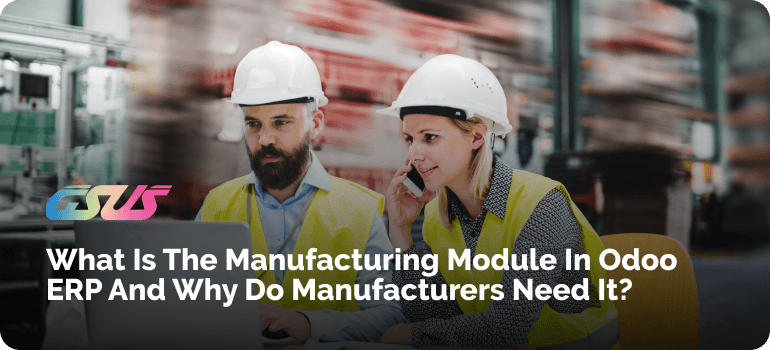
The Odoo Manufacturing Module specifically handles the production side of things, and once you see how it connects with the rest of the system, it's hard to go back to the old way.
What Is the Odoo Manufacturing Module, and Where Does It Fit?
What Does the Odoo Manufacturing Module Actually Handle?
Think of it as the brain of your production floor. You use it to build Bills of Materials, create manufacturing orders, assign work centers, track material usage, and record finished goods, all in real time.
It lives inside the larger Odoo ecosystem, which means every move it makes talks to inventory, purchasing, accounting, and sales automatically. No manual handoffs. No, can you update the sheet?
That kind of connected workflow is exactly what Modern Manufacturing ERP Software should deliver. And honestly, most traditional systems fall short of it.
Who Actually Gets Value from Odoo Manufacturing?
Here's what's interesting; it's not just for big factories. The module scales across very different business sizes:
Small manufacturers use it mostly to stop relying on spreadsheets. Just that alone saves hours every week.
Mid-sized companies use it more heavily, multiple work centers, shift management, and production scheduling. Large enterprises push it further into multi-site coordination and complex routing across departments.
The point is you don't need to be running 500 SKUs to justify it. Even a 15-person production team sees a real difference.
What Are the Key Features of the Odoo Manufacturing Module Worth Knowing About?
Does BoM Management Help, or Is It Just Another Setup Headache?
Honestly? Setting up your Bill of Materials properly takes upfront work. But once it's done, it pays for itself constantly.
Every production order pulls from that BoM automatically, right components, right quantities, right cost assumptions.
You can also build multi-level BoMs if your product has sub-assemblies, which is common in electronics, auto parts, and furniture.
A quick example: say a furniture company makes a dining chair. The main BoM lists the frame, cushion, and fasteners.
But the cushion itself has a sub-BoM, fabric, foam, and stitching. Change the foam supplier? It updates across all related production orders instantly.
How Do Work Centers and Routing Actually Improve Production Flow?
Work centers are basically the stations in your factory, a cutting machine, an assembly bench, and a finishing line. Routing tells the system which work center handles which step, and in what order.
When these are set up in Odoo, production managers can finally see where a job is at any given moment. More importantly, you can spot bottlenecks before they become delayed.
If the welding station is running at 90% capacity and you're about to schedule three more jobs through it, the system shows you that before you commit, not after you've missed a delivery date.
Can Odoo Production Planning Actually Handle Real Scheduling Needs?
Yes, though the depth depends on how you configure it. Manufacturing orders can be scheduled with start and end dates, linked to work center availability, and adjusted based on capacity.
The Master Production Schedule feature is especially useful for companies dealing with seasonal swings in demand; it gives you a forward view of what you need to produce and when raw material procurement must happen.
A beverage company running summer production for a seasonal drink, for instance, needs to plan ingredient orders months out. That's where Odoo Production Planning genuinely earns its place.
What About Inventory? Does It Actually Sync in Real Time?
This is one of those features that sounds obvious but makes a massive practical difference.
Every material issue, every output recorded, every bit of scrap; it all hits inventory immediately.
You're not waiting for a day-end sync or a manual update from the warehouse team.
With Odoo Inventory and Manufacturing connected, reorder rules automatically kick in when a component drops below a set level.
The purchase team is notified. The material arrives. Production doesn't stop. That's the whole idea.
How Does Quality Control Work Within the Manufacturing Process?
You can set quality checkpoints at any stage, incoming materials, during production, and final inspection before shipping.
If something fails to check, the system flags it and can block the order from moving forward until it's resolved.
For industries like food processing or medical device manufacturing, this isn't a nice-to-have; it's a regulatory necessity.
Even outside those sectors, catching defects in mid-process is always cheaper than catching them after packaging.
What Is Shop Floor Management and Why Should Operators Care?
Odoo Shop Floor Management gives your operators a simple, tablet-friendly screen to log work in real time, what they've produced, what materials they pulled, whether a machine had downtime.
No paper forms. No end-of-shift data dumps that lose half the detail.
For production managers, this is genuinely game-changing. Instead of waiting for a morning report, you get live visibility on output versus target.
You know by 10am whether you're on track, not at 4pm when it's too late to course correct.
What Common Manufacturing Headaches Does Odoo ERP Actually Solve?
The Inventory Problem - Too Much or Too Little
Overstocking locks up cash. Understocking stops production. Both are symptoms of the same problem: not enough real-time visibility into what you have and what you're about to need.
Odoo's demand-driven planning handles both ends of that problem by connecting consumption data directly to procurement triggers.
Why Do Production Delays Keep Happening?
Usually it's one of two things, a planning gap or a communication gap. When work orders, routing sequences, and capacity constraints all live in one place; those gaps close. Delays still happen, but they're visible earlier, which means you can act on them rather than just react to them.
Nobody Can See What's Actually Happening on the Floor
Running manufacturing from spreadsheets means you're always looking at stale data. By the time someone updates the sheet, the situation has already changed.
Odoo gives you a live picture: what's in progress, what's queued, what's overdue.
Quality Issues Slipping Through
When quality checks are embedded into the production workflow, not handled as a separate post-production step, defects get caught earlier.
Earlier means cheaper to fix. And the data from those checks feeds into reports that help you spot patterns over time, not just individual failures.
Data Entry Errors Eating into Accuracy
When you're re-entering the same data across three systems, errors are inevitable. Manufacturing Management Software that shares one database eliminates that duplication entirely. Enter it once, correctly, and it flows where it needs to go.
Why Do Manufacturers Actually Need the Odoo Manufacturing Module?
Here's a real situation worth walking through. A mid-sized garment manufacturer had production tracking in Excel, inventory in a separate legacy system, and quality records on paper printouts.
Their production managers spent roughly two hours every single morning just reconciling data before they could start making decisions.
With Odoo, that reconciliation is automatic. Those two hours went back to business every day.
That's what production efficiency actually looks like. Not a dramatic overnight transformation, but a consistent daily improvement that compounds over time.
Better inventory control means fewer last-minute emergency orders. Enhanced product quality means fewer returns.
Reduced manual work means fewer costly errors. And when your data is accurate and centralized, data-driven decision-making stops being a phrase and starts being something you do.
At GSUS, an official Odoo Silver Partner, we've implemented this across manufacturers in multiple industries.
The difference between a smooth rollout and a frustrating one almost always comes down to how the system is configured, not the software itself.
How Does Odoo Manufacturing Connect with the Rest of Odoo's Modules?
This is where things get genuinely powerful. The Odoo modules aren't just connected; they share the same data foundation.
The Inventory Module updates stock in real time every time materials are issued or output is recorded.
The Purchase Module can automatically raise purchase requests when components drop below reorder points; no human needs to notice and act.
The Sales Module links confirmed customer orders directly to manufacturing orders, so production knows exactly what's demanded and when.
The Accounting Module captures production costs, materials, labor, overhead, without anyone from finance touching a spreadsheet.
The Maintenance Module schedules equipment checks and handles breakdown responses, reducing the downtime that throws production schedules off.
The whole information flow works like this: a sale confirms → a production order is created → inventory checks availability → purchasing fills gaps → accounting records costs → maintenance keeps machines running.
That's one continuous thread across departments, with no manual connections required.
Which Industries Benefit Most from Odoo Manufacturing?
Automotive Manufacturing
Component traceability is non-negotiable in automotive. With multi-level BoMs, strict supplier tracking, and quality documentation at every stage, Odoo handles all of it. If a defective batch surfaces, you can trace it back to the source in minutes, not days.
Electronics Production
Version-controlled Bills of Materials, serialized inventory tracking, and assembly-stage quality checks make Odoo a natural fit here.
When a product gets a component revision, the BoM updates cleanly without disrupting active production orders.
Food and Beverage Industry
Batch tracking, expiry date management, lot traceability, and compliance-based quality checks are all built in.
For a beverage manufacturer preparing a recall scenario, being able to trace every ingredient lot in a finished product isn't optional; it's survival.
Furniture Manufacturing
Configurable products with dozens of variants, material consumption tracking by job, work center routing through cutting, assembly, and finishing, all maps cleanly into Odoo's structure.
Textile and Apparel
With color and size variants across large production runs, fabric consumption by order, quality inspection at cutting and stitching, Odoo's flexibility manages the complexity without requiring custom development.
Odoo Manufacturing vs. Traditional Manufacturing Systems - Is It Actually Better?
Feature Odoo Manufacturing Traditional Systems Automation Built-in across modules Limited, often manual Real-Time Visibility Live Dashboards Batch updates, often delayed Integration Native across all modules Usually requires middleware Scalability Grows with your business Often vendor-dependent Cost Efficiency Modular, pay for what you need High licensing and customization costs
Traditional manufacturing ERP systems tend to need expensive customization to do what Odoo does out of the box.
And when your departments are each running separate tools, integration becomes its own ongoing project, one that someone must own and maintain indefinitely.
What Are the Best Practices for Implementing the Odoo Manufacturing Module?
Map Your Real Workflows First
Before touching any configuration, document how production actually works today. Not how it's supposed to work, how it works. That's what the system needs to match.
Get Your Bills of Materials Right Early
Garbage in, garbage out. BoMs are the foundation. If they're wrong, every production order, every cost estimate, and every inventory movement built on top of them is also wrong. Spend the time here.
Train the People on the Floor, Not Just Management
The system only delivers value when your operators use it in real time. That means practical, hands-on training, not a PDF manual, and a password.
People need to understand why the system works the way it does, not just how to click through it.
Review KPIs Weekly
Set up dashboards for production yield, on-time delivery rate, scrap percentage, and OEE. If you're not reviewing these regularly, you're not using half of what the system can tell you.
Connect the Related Modules from Day One
Don't implement manufacturing in isolation and plan to "add inventory later." The value comes from the connections. Inventory, Purchase, and Maintenance should go live alongside Manufacturing.
Is the Odoo Manufacturing Module the Right Choice for Your Business?
If you're currently managing production on spreadsheets, or on a system where every department is doing their own thing, the honest answer is that you're burning time and money every day, even if you can't see exactly where it goes.
Odoo ERP pulls it together: production planning, shop floor visibility, inventory accuracy, quality control, purchasing, and finance, one system, one source of truth.
It scales from a small workshop to a multi-site enterprise. Because it's modular, you start with what you need and add more as the business demands it.
Conclusion
Manufacturing is already complicated. Your software shouldn't make it harder.
The Odoo Manufacturing Module gives you real control over production planning, inventory, quality, and shop floor operations, and connects all of it to the rest of your business automatically.
If you're serious about cutting waste, improving delivery performance, and making decisions on actual data, this is worth a proper look.
GSUS is an official Odoo Silver Partner with hands-on experience Implementing Odoo for Manufacturing across industries.
We'll help you configure it to fit how your production actually works, not the other way around. Want to see it in action?
Schedule a consultation with the GSUS team.
Request a demo built around your production setup.