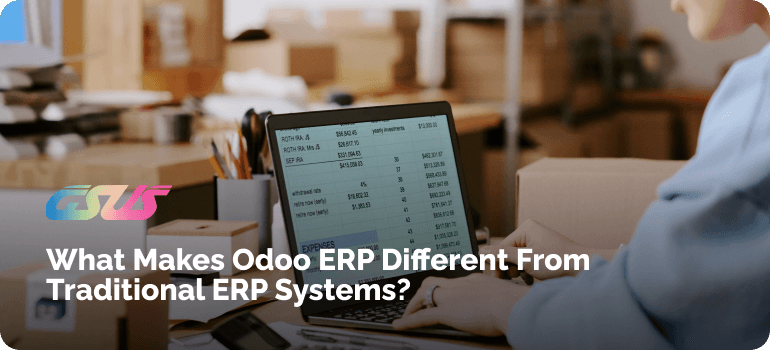
What businesses require today are ERP solutions that are flexible, scalable, and cost-effective, and this is where Odoo shines.
However, if you have been using a traditional ERP for years, changing to a new one can be daunting. You've no doubt heard the buzz in boardrooms: SAP, Oracle, Microsoft Dynamics... and this new player on the scene, Odoo ERP, which is making some serious inroads.
So, what's the actual difference? More importantly, which one is suitable for your business? So, let's get down to the truth of the matter, no jargon, no smoke, and mirrors.
What are Traditional ERP Systems and why do businesses still rely on them?
There are traditional ERP systems, such as SAP, Oracle EBS, and Microsoft Dynamics, that have been in existence for many years.
Designed to provide a single, large system for centralizing core business functions – finance, HR, procurement, supply chain. They were extremely viable in large enterprises with vast IT budgets.
However, these platforms are at an earlier time and have been built differently. It usually takes several months (even years) to implement, and a staff of specialized consultants and the licensing fees can be hundreds of thousands of dollars per year. Customization? Yes, but it will cost you a lot!
In most cases, small and mid-sized businesses were between the rock and the hard place: They wanted the features of an ERP, but none of the traditional options fit the budget, flexibility, or complexity they needed. It is where Modern ERP Solutions such as Odoo excel.
What is Odoo ERP and why is everybody talking about it?
Odoo ERP is an open-source business management system that encompasses the entire business, including CRM, sales, accounting, inventory, HR, manufacturing, and eCommerce. Its key distinguishing feature is its modular design.
Do not have to purchase the entire one at once. You choose the modules that you really need and then add more as your business expands.
It works on the cloud and on-premises, meaning companies with data sovereignty requirements or those who prefer to host on-premises aren't forced to use a one-size-fits-all deployment. The modules are all good,
Automate marketing follow-up, track leads, and manage pipelines. Automate marketing follow-up, track leads, and manage pipelines.
- Sales - quotes, orders, and invoicing, all in one flow!
- Inventory - real-time stock visibility and warehouse management.
- Accounting, full double entry bookkeeping and automated accounting reconciliation.
- HR - Payroll, Leave Management, Recruitment, Appraisals
- Production Orders: Manufacturing, Bill of Materials, Quality Control.
- eCommerce - fully-integrated online store that links to inventory and accounting
Each module communicates with each other natively – no painful integrations or data silos.
What are the Differences between Odoo ERP and Conventional ERP Systems?
But does Architecture really mean more flexible?
Yes, and this is probably the most significant difference. Traditional ERPs are developed as single applications. It is not always easy to enable/disable certain features, and often the system imposes pre-determined processes to be followed.
Odoo ERP is a modular ERP solution. If a startup just requires CRM and invoicing, they don't need to spend money or deal with the hassle of using other modules.
A manufacturing enterprise that expands eCommerce can include that module later without rebuilding the system. Most legacy platforms can't provide this sort of agility.
What About the Cost Difference?
That's where the Manufacturing ERP Systems really get butted heads. For mid-market companies, the costs for platforms such as SAP can be millions. Then factor in annual licensing and support, and customization, and it's a serious long-term commitment.
Odoo ERP provides an extremely reduced total cost of ownership. The Community edition is open source and free.
The Enterprise version is available in a cloud offering, with more advanced features and Odoo support and costs depending on the number of users you use per month, scaling seamlessly with your staff. For the majority of SMEs, the answer is getting 80-90% of the functionality at a fraction of the cost.
So, is Odoo ERP Easier to Use?
It's no secret that legacy ERP interfaces are daunting. Many have hardly had any changes at all in appearance in 15 years, and new people require weeks of training before starting to be productive.
Odoo's user interface is modern and clean with a real intuitive design. The experience of the dashboard is more SaaS than enterprise. The uptake in the workplace tends to be quicker, and therefore can directly affect ROI, after all, even the best ERP can be as powerful as a bull in a China shop if employees don't use it.
Get Up and Running in No Time!
The typical ERP implementation timeline is anywhere from 12 to 24 months. For a business on the rise, it's an agonizing delay.
In a few weeks or a few months, you can go live with Odoo ERP, particularly in standard configurations. Businesses can begin to reap benefits much quicker than with legacy options, with the right Odoo ERP Implementation Partner and clear requirements.
Is Odoo suitable for the industry?
One frequently asked question is, “Can an open source platform really manage complex, industry specific processes?” Yes – with proper implementation.
Businesses in manufacturing, retail, healthcare, logistics, eCommerce and professional services can customize workflows in Odoo to suit their needs.
Its open architecture will allow a skilled Odoo developer to create almost anything without any restrictions due to rigid licensing.
What About Integrations?
Odoo ERP comes with REST and XML-RPC interfaces preconfigured. It also features a rapidly expanding native integration with tools such as Shopify, WooCommerce, Amazon, payment gateways, shipping providers, and more.
For similar functionality and purpose, traditional ERPs need to install expensive middleware or certified connectors.
Why are businesses making a concerted effort to move away from traditional ERP?
It's not only about the price. Companies are discovering more that legacy systems are inflexible and hinder their response to change.
As sales channels evolve, businesses move and expand, or workflows change because of a merger; traditional ERPs can be more of a constraint than a solution.
There has been a significant rise in the demand for agile ERP solutions, especially from SMEs that don't have enterprise-sized budgets. Many sectors are innovating and rapidly changing, and they require systems to keep up. Logistics, retail, manufacturing, and other industries are rapidly changing and in need of systems to evolve fast.
The centralized data management, real-time reporting, and process automation provided by Odoo can provide operations teams with visibility and control that can be more difficult to achieve in traditional ERP systems, especially without heavy customization fees.
What is the true value of Odoo ERP in real life?
Switching businesses generally experience:
- Greater productivity - automation takes care of repetitive work, while freeing teams up to focus on more productive activities.
- Improved data visibility - real-time dashboards provide up-to-the-minute numbers to leadership without the wait for reporting
- Enhanced customer relationships – CRM module ensures that customer is in synch with sales and support.
- Faster decisions - when all your finance, inventory and sales data is in one system, decisions are made faster and with more confidence.
- Reduced operational complexity - less diverse and fragmented tools, reduced manual reconciliation, less break.
Clearing Up the Misconceptions About Odoo ERP
Odoo is just a small business solution. Not true. Odoo is intended for businesses with thousands of employees and complicated multi-entity businesses. It can scale up just as easily as it does for startups.
Open source is less secure," Thomas said. Open-source means the code is transparent (which, in fact, may help the security researchers to detect and rectify vulnerabilities more quickly).
Odoo Enterprise comes with dedicated security patches and support, and businesses running Odoo Enterprise on Odoo.sh or other enterprise-grade infrastructure have high-security standards to adhere to.
Customization is too complex. Customization is well managed and cost-effective with the right implementation partner of Odoo. It's not the platform that is the real risk; it's the fact that you are going to a partner who doesn't know your business.
“Implementation of ERP systems is too costly and costly.” Odoo ERP implementation is quite cost-effective and quicker than the traditional ERP. It is not the platform; it's mainly project management and planning.
Why Choose GSUS for Your Odoo ERP Implementation?
The importance of the right partner can't be underestimated, next to selecting the right platform.
GSUS is an Odoo Silver Partner, that is why we have been thoroughly checked by Odoo for technical skills, implementation quality and client satisfaction. It is not something you earn when you join. It demonstrates a proven track record of delivering results.
With a team of seasoned Odoo consultants and developers, we can learn about the client's processes and only write lines of code or configure modules after understanding them.
We've seen the failures of ERP projects, and it usually follows this pattern: An ERP system is configured for someone else's business, not yours.
What GSUS delivers:
- Odoo consultation to review your existing solutions and plan the appropriate solution design
- Industry-specific, workflow-specific end-to-end ERP implementation
- Odoo customization services for requirements that extend beyond the Odoo functionality.
- Businesses reap the benefits of migration from legacy ERPs.
- Third-party integration with the tools that your team already uses
- Post launch maintenance and support so you're not left to your own devices
Clients select GSUS for technical expertise and business knowledge.
We have applied ourselves to projects in manufacturing, retail, logistics, healthcare and services, and we know that each of these businesses has processes that go beyond the standard configuration. Well, it's not a problem, it's what we do.
In conclusion: Which ERP is the best for long-term growth?
But the truth is that for most growing companies today, Odoo ERP provides a much more promising solution than any of the traditional ERP systems, more flexible, cheaper, quicker, and user-friendly.
Traditional ERPs are not disappearing - indeed, for very large companies with very specific needs and the budget to support them, traditional ERPs remain a good idea.
For the overwhelming majority of companies aiming to modernize their operations, Odoo is the perfect fit that legacy platforms have never been built for.
The right ERP isn't the most expensive; it's not the most popular. It's the one that suits your business, your team, your growth plans, and one that you make full use of.
Looking for a change?
Want to upgrade your business operations with Odoo ERP? As an Odoo Silver Partner, GSUS provides tailor-made ERP solutions for businesses to grow smarter and faster.
From the initial assessment of Odoo to migration from an existing platform or optimizing an existing Odoo deployment, we've got your back covered!