Last month, a steel business owner told us something that was stuck. His billing team had been raising invoices for processed spoons at 18% GST, the same rate they used for raw stainless-steel sheets.
Nobody caught it for three months. By the time their CA flagged it during GSTR reconciliation, they had already issued dozens of incorrect invoices and owed a stack of credit notes.
Here's the thing; they knew the GST rates. The rate for steel sheets is 18%. The rate for steel spoons is 5%. That wasn't the problem.
The problem was that nobody had built that difference into their billing system. So, every time someone raised an invoice for spoons, they picked up the rate they remembered, which happened to be the rate for sheets.
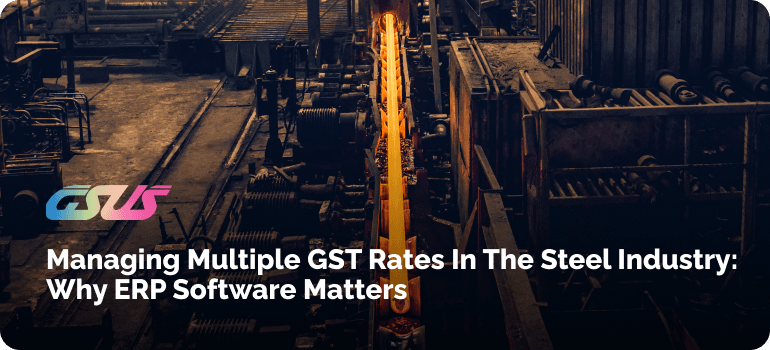
This is what Managing Multiple GST Rates in the Steel Industry looks like on the ground. Not a lack of knowledge. A gap between what people know and what their systems enforce.
And when your business is running hundreds of invoices a month across raw materials, semi-finished goods, finished products, and trading stock, that gap has consequences.
Why GST Compliance Is Becoming More Complex for Steel Businesses
Let's be honest about something: steel is one of the messier sectors when it comes to GST.
Not because the rules are unclear, but because the sheer variety of what steel businesses produce and sell means you're almost always dealing with multiple tax rates at once.
Think about a mid-sized steel manufacturer. On any given day, they might be selling raw coils at 18%, fabricated structures at 18%, kitchen utensils at 5%, and certain alloy products at 12%.
Now add to that the fact that many of these businesses also do inter-state sales, which switches the tax treatment from CGST/SGST to IGST entirely.
Then there's the HSN classification side of things. Getting the HSN code wrong doesn't just mean the wrong tax rate on that invoice; it can trigger mismatches in GSTR-1 vs GSTR-2A, ITC disputes, and in some cases, GST notices.
Steel businesses with a broad product range often have 80–150 active HSN codes. Keeping that accurate manually is genuinely hard.
Add high transaction volumes, and GST Compliance for Steel Industry. Businesses stop being a finance function and start being an operational risk.
From 18% Steel to 5% Utensils: Why Product Classification Matters
This is worth spending a moment on, because it surprises people who haven't thought about it before.
How One Raw Material Can Have Different GST Outcomes
Take a single raw material, stainless steel sheet. Depending on what you do with it, the GST rate changes completely:
- Stainless steel sheet in raw form → 18% GST
- Turn it into a spoon → 5% GST
- Press it into a plate or bowl → 5% GST
- Fabricate it into an industrial bracket or enclosure → back to 18% GST
Same material, four different tax treatments. What determines the rate isn't what went into the product; it's what the product has become, and which HSN code it now sits under.
The Role of HSN Codes in Determining GST Rates
A lot of people treat HSN codes as a technicality, something you fill in because the invoice format requires it. That framing gets businesses into trouble.
The HSN code is actually the tax identity of your product. It determines the GST rate, governs ITC eligibility in certain scenarios, and is what the government uses to reconcile what you've declared against what your buyers have claimed.
HSN code management for steel products isn't paperwork. It's a core compliance infrastructure.
When you're dealing with product variants, different gauges, different finishes, different end-use applications, some of those variants sit under different HSN codes with different rates.
Without a system that maps those correctly and automatically, someone on your billing team is making a judgment call on every single invoice. Some of those calls will be wrong.
Common GST Challenges Steel Businesses Face Without ERP Software
We've spoken to enough steel businesses to know the pain points are pretty consistent. Here's what comes up again:
Manual GST Rate Selection During Billing
Billing teams pick rates from a dropdown; a rate card pinned to the desk, or memory. Works fine for a small product range. Falls apart fast when you have 60 products, and half of them have variant-level differences.
Someone raises a 5% item at 18%, and it goes out the door. The customer pays extra, you've collected excess tax, and now both of you have a reconciliation problem.
HSN Code Errors Across Product Variants
Two products might look almost identical, same material, slightly different spec, but fall under different HSN codes.
Without a product master that enforces the right code automatically, billing staff relies on their own classification skills. Which, fairly, they weren't hired to have.
Input Tax Credit Reconciliation Issues
Input tax credit management in the steel industry is particularly tricky because of the rate of mismatch between inputs and outputs.
You're buying raw steel at 18% but selling finished goods at 5%, which means ITC accumulates, and you may be eligible for refunds.
But claiming that correctly requires clean, detailed records of every purchase invoice, every HSN code, every GSTIN match.
Without integration, that data is scattered across systems, and the reconciliation takes days.
Inventory and GST Mismatches
When stock records live in one place and billing records live somewhere else, they drift. A dispatch happens, the invoice goes out with one set of product details, and the inventory system hasn't been updated to match.
By the time someone notices, you're reconciling two different versions of reality at the end of the month.
Last-Minute GST Return Preparation
You know this one. It's the 19th of the month and your accountant is pulling data from three different sources, checking it against purchase registers, and manually uploading it to the GST portal.
One wrong entry creates a mismatch that takes weeks to sort out. It's stressful, it's slow, and it's entirely avoidable with the right system.
Why Excel and Disconnected Systems Are No Longer Enough
Most steel businesses we talk to have some version of the same setup: billing software for invoicing, spreadsheets for inventory (or a basic WMS), Tally for accounts, and GST filing done by exporting from all three and reconciling manually.
For a business doing 20–30 invoices a month, that's manageable. For a business doing 300+, it's a liability.
The specific risks of this fragmented approach:
- Data entered in one system doesn't automatically flow to others, so manual re-entry happens, and manual re-entry means errors
- There's no single source of truth for your GST position, what do you owe, what can you claim, what's been filed?
- If one person leaves who understood how all the pieces fit together, institutional knowledge walks out with them
- Audits become exercises in finding and assembling data that should have been consolidated all along
- Manual GST compliance challenges don't really announce themselves until something breaks, a GST notice, a failed audit, and a cash flow gap from `missed ITC.
By then, the cost of fixing it is much higher than the cost of getting the right system in place to begin with.
How Odoo ERP Helps Steel Businesses Manage Multiple GST Rates
Rather than treating GST as something you deal with at the invoicing stage, Odoo builds tax logic into the product setup itself.
You configure the GST rate and HSN code once, at the product level, and every transaction that involves that product inherits those settings automatically. No manual selection. No rate cards on desks.
Automated GST Mapping Based on Product Classification
Every product in Odoo carries its GST configuration, rate, HSN code, tax type, as part of its master data.
When someone creates a sales order or invoice, the system applies the right tax automatically based on the product selected and the customer location. The billing team doesn't need to know the GST rates. The system does.
Centralised HSN Code Management
Instead of HSN codes scattered across spreadsheets or remembered by individuals, Odoo holds them in a single product master.
When the GST council updates classifications, and this happens, you update it in one place, and it flows everywhere.
No circular emails, no updated rate cards, no hoping someone remembers to change the dropdown.
GST-Compliant Invoicing and Tax Calculations
Odoo knows the difference between an intra-state and inter-state transaction and applies CGST/SGST or IGST accordingly.
It handles invoices with multiple product lines at different GST rates in the same document.
And the invoice output is already in a format that works for GST filing, no reformatting, no data extraction.
Real-Time Inventory and Tax Visibility
Odoo connects inventory and accounting, so they move together. When goods are dispatched, the stock record updates and the accounting entry are created in the same transaction.
Your inventory position and your GST records stay in sync, not because someone reconciles them, but because they're the same system.
Better Input Tax Credit Tracking
Every purchase in Odoo records the supplier's GSTIN, the HSN code, and the GST paid. Your ITC ledger builds itself as transactions happen.
At any point, your team can see exactly what credit is available, what's been utilised, and what's pending, without running a reconciliation exercise.
Faster Adaptation to GST Updates
When rates change, it's a configuration update, not a system-wide fire drill. Change the tax on the affected products, and every subsequent transaction picks up the new rate. Historical transactions stay as they were. No retroactive errors.
GSUS is an Odoo Silver Partner focused on manufacturing and trading businesses across India. We've Implemented Odoo specifically for steel businesses, configuring product masters, HSN mappings, tax rules, and compliance workflows that match how steel companies operate. Not a generic setup.
Key Odoo ERP Modules That Support GST Management in the Steel Industry
One thing that's easy to miss about Odoo is how the modules actually talk to each other. Most businesses have experienced Integrated Software that isn't really integrated; you still export one module and import into another.
Odoo is genuinely connected. Here's what that looks like across the modules that matter most for steel businesses:
Sales Module
Customer orders flow directly into invoicing. GST rates and HSN codes pull from the product master without any input from the sales team. Inter-state vs intra-state is determined by the customer's address.
From quotation to tax-compliant invoice, the sales module closes the loop automatically.
Inventory Module
Stock movements trigger accounting entries in real time. So, when your warehouse dispatches a consignment, the inventory records and the corresponding GST entry are made simultaneously. No lag, no manual step, no mismatch to fix later.
Manufacturing Module
For steel businesses that transform raw material into finished goods, this module matters a lot for GST purposes. The manufacturing process changes the product classification, which changes the GST rate.
Odoo tracks that transformation, so the finished goods that come out of production carry out the right tax configuration, not the raw material rate.
Accounting Module
This is where it all comes together. GSTR-1, GSTR-3B, and reconciliation reports are built from actual transaction data, not assembled by someone copying numbers from three different places. Month-end closes faster and with far less manual intervention.
Purchase Module
Supplier invoices come in with their GST details, and the purchase module validates them against what was expected.
ITC gets recorded against each purchase automatically, and that data feeds straight into the accounting module's ITC ledger.
For a steel business that's purchasing material at volume, this is where a lot of cash flow clarity lives.
Business Benefits of Using ERP Software for GST Compliance
The features matter only because of what they produce. Here's what steel businesses tend to see after moving to an Integrated ERP for GST Management:
- Billing errors drop significantly, not because the team got more careful, but because the system no longer allows the common mistakes
- ITC recovery improves, because credits that were previously missed or miscalculated are now tracked from the moment a purchase is made
- Month-end closes in days instead of weeks, because the reconciliation work happens in real time rather than all at once
- Finance teams spend less time chasing data and more time doing actual financial work, analysis, forecasting, planning
- Audits become much less stressful because every transaction is traceable and every calculation is documented
- The business can grow, more SKUs, more volume, more locations, without proportionally more compliance risk
The digital transformation of steel businesses often sounds like an abstract goal. In practice, a lot of it comes down to exactly this: removing the manual effort and human error from things that a well-configured system should handle automatically.
Is Your Steel Business Ready to Handle the Next GST Change?
GST has been amended multiple times since 2017. Rates have shifted, HSN code requirements have been updated, and return formats have changed.
Each time that happens, businesses with proper ERP systems adjust their configuration and keep running.
Businesses on manual systems hold a team meeting, update spreadsheets, brief billing staff, and then quietly hope nobody slips up in the first few weeks.
A few questions worth being honest with yourself about:
- If the GST rate on one of your product categories changed tomorrow, how long would it take to update every place that rate appears in your business?
- Can you tell, right now, what your ITC balance is, without running a separate reconciliation?
- How many hours a month does your team spend on GST-related data that, in a well-integrated system, would happen automatically?
- In your last GST audit or return review, were there mismatches? If so, where did they come from?
- These aren't hypothetical questions. They're the difference between being GST-ready as a business or being permanently one step behind the compliance curve.
GST readiness for manufacturers today isn't about understanding the rules; it's about having systems that apply them reliably at scale.
Conclusion: Managing GST Complexity Requires More Than Spreadsheets
Here's the honest version of the problem: GST rate changes are not really the issue. Steel businesses generally know their rates.
The issue is what happens between knowing the rate and getting it right on every invoice, every purchase, every stock movement, every return, consistently, at volume, without a dedicated compliance team manually checking every step.
Managing multiple GST Rates in the steel industry is ultimately an operational problem. It lives in your billing workflow, your product master, your inventory records, and your reconciliation process.
A spreadsheet can't solve that. A disconnected billing tool can't solve that problem. An integrated ERP system, configured specifically for how steel businesses work, can.
With the Right ERP Software in place, steel businesses spend less time on compliance with firefighting and more time on what grows the business, better margins, faster fulfilment, smarter procurement.
We are Odoo Silver Partner with direct experience implementing Odoo ERP for steel manufacturers and traders in India.
If the challenges in this blog sound familiar, billing errors, ITC gaps, month-end reconciliation stress, we're happy to walk you through what a proper Odoo implementation looks like for a business like yours.