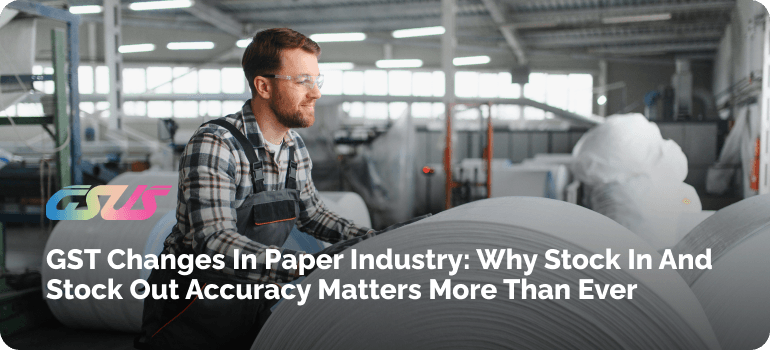
If you run a paper business in India, whether you're a mill, a trader, a corrugated box manufacturer, or a printing house, the last few GST revision cycles have probably given you more headaches than just tax filings.
The GST changes in the paper industry that kicked in from September 2025 didn't just tweak a few numbers. They quietly triggered a chain reaction that's now showing up in places most businesses weren't even watching: their stockrooms.
Let's talk about what's happening on the ground, why Inventory Management is now more critical than ever, and how businesses are starting to fix it.
How GST Changes Are Affecting Paper Industry Operations
GST Rate Changes and Classification Complexity
The 56th GST Council recommendations brought in sweeping changes for paper products, and the rate of revisions weren't simple across-the-board shifts. Different paper grades got treated very differently.
Newsprints stayed at 5%. Wood pulp inputs dropped from 12% to 5%, which is a relief for mills on the raw material side. But several finished goods, writing paper, printing paper, kraft paper, and coated paper, moved from 12% to 18%. Packaging-grade papers and some carton materials dropped to 5%, while exercise books and educational papers became nil-rated.
On paper (no pun intended), this looks like a mixed bag. In practice, it created immediate chaos at the product classification level.
Businesses started asking: which HSN code applies to my exact product? Is this kraft paper at 18% or does it fall under a packaging grade at 5%? Is this coated paper used for printing or packaging?
That kind of ambiguity is expensive when you get it wrong on your GST invoices.
Impact on Pricing, Margins, and Compliance Pressure
The most painful shift hit paper mills and trading firms that deal primarily in printing and writing paper. Their output GST jumped to 18%, and while input tax credit availability improved some, the cash flow mismatch became immediate.
Businesses that were running tight margins started recalculating pricing, and many found their old selling price structures no longer held up.
The GST changes in the paper industry also added compliance pressure. Rate transitions mean old stock invoiced at 12%, and new stock at 18% were moving through the same warehouse at the same time. If your stock records weren't clean going into the transition, they got messier fast.
The Hidden Problem - Stock In and Stock Out Mismatch in Paper Businesses
Here's what the broader industry conversation isn't focusing on enough: the GST transition exposed deep inventory management problems that were already there.
Why Stock Tracking Becomes Critical During GST Transition
When GST rates change mid-year, you suddenly have two versions of the same product sitting in your warehouse. Old stock procured at 12% GST. New stock arriving at 18% or 5%.
They might look identical, same weight, same grade, same reel size, but they have completely different tax implications on your books.
If your stock-in and stock-out records are handled manually or through disconnected spreadsheets, you're almost certainly mixing these batches.
Your sales team might be issuing invoices using old tax rates on new stock, or vice versa. Your accounts team is reconciling figures that don't add up.
And by the time you catch it, the mismatch has compounded across dozens of transactions.
This isn't a hypothetical scenario. Paper traders and mid-size mills reported exactly this kind of reconciliation headache in the months following the GST changes in paper industry implementation.
Manual Systems vs Real-Time Inventory Control
Manual inventory tracking, whether its Excel sheets, tally entries done at day-end, or even basic accounting software that doesn't speak to your warehouse, creates a blind spot.
You might know what came in last week, but do you know what's sitting in Bay 3 right now, which batch it belongs to, and what GST rate applies when it goes out today?
In paper manufacturing and trading, where products move fast and volumes are high, that blind spot translates directly into lost money, either through incorrect GST filings, ITC reconciliation errors, or stock write-offs that shouldn't have happened.
Why Manual Inventory Systems Fail After GST Changes
Spreadsheet-Based Stock Tracking Limitations
Let's be honest about what spreadsheets can and can't do. They can store data. They can't validate it in real time. Someone enters a wrong batch number, and there's no system-level check to catch it.
Someone forgets to update the sheet after a weekend to dispatch, and your stock figure is wrong for the next three days.
Paper businesses often have multiple product grades, multiple godowns, and frequent movement of reels, sheets, and cartons.
Managing all this manually means you're always working with yesterday's picture of your inventory. In a compliance environment where GST audits look at invoice-level stock movement, that's a real risk.
Impact on Business Decisions and Profitability
Poor stock tracking doesn't just create compliance problems. It leads to bad business decisions. You over-order a grade you already have in surplus because your records don't reflect what's on the floor.
You promise a delivery date you can't meet because you assumed stock was available when it wasn't. You carry dead stock for months because no one flagged slow-moving items in time.
The GST changes in the paper industry didn't create these problems, but they made it impossible for them to ignore. Businesses are now being forced to look at stock accuracy in a way they never had to before.
How Odoo ERP Solves Stock In and Stock Out Problems in Paper Industry
This is where things start to get better.
Real-Time Inventory Tracking with Odoo ERP
Odoo ERP gives paper businesses a live, unified picture of their inventory. Every stock-in and stock-out movement is recorded at the moment it happens, not at day-end, not whenever someone gets around to updating a sheet.
Whether it's a raw material receipt at the mill gate or a dispatch to a distributor in another city, the system updates in real time.
For paper businesses handling multiple grades and batch sizes, the lot and batch tracking feature in Odoo is particularly valuable. You can tag each incoming batch with its GST rate, supplier details, and procurement date.
When that stock goes out, the system knows exactly which batch it came from and generates the correct tax values automatically. No manual cross-referencing. No rate of confusion between old and new stock.
GST Compliance Automation Using Odoo ERP
One of the biggest advantages of running Odoo ERP for paper industry operations is the built-in GST compliance layer.
Tax rules are mapped at the product level, so when your sales team creates an invoice for kraft paper, the correct 18% GST (or whatever rate applies to your specific HSN code) is applied automatically.
There's no dependency on the person raising the invoice, remembering which rate to use.
At GSUS, we work with paper businesses as an Odoo Silver Partner, and one of the most common things we help clients set up is this exact tax-mapping configuration.
Getting the product-HSN-tax linkage right from the start saves enormous reconciliation effort down the line.
Odoo also supports GSTR generation directly from the system, so your monthly filings pull from the same transactional data that drives your invoices and stock records. No more exporting to a separate tool and manually matching figures.
Integration Between Inventory, Sales, and Accounting
Perhaps the most underrated benefit: Odoo connects your warehouse, your sales desk, and your accounts department into one system.
When a delivery is made, the stock level drops, the invoice is generated, and the accounting entry is posted, all without anyone manually triggering three separate actions in three separate tools.
For paper businesses dealing with the GST changes in the paper industry, this kind of integration means that ITC (Input Tax Credit) tracking becomes automatic.
You can see, at any point, how much ITC you've accumulated, which supplier invoices are matched, and what refunds you might be eligible for due to inverted duty structures.
Benefits of Accurate Stock In and Stock Out Tracking After GST Changes
Improved Profitability and Reduced Stock Loss
When you know exactly what you have and where it is, you stop buying what you don't need and stop losing what you do.
Paper warehouses with accurate batch-level tracking report significantly lower write-offs from damaged, expired, or misplaced stock.
Better Working Capital Management
The inverted duty structure issue, where inputs are taxed higher than outputs for some paper grades, creates ITC accumulation.
Businesses that can file clean, well-documented refund claims to get their money back faster.
That working capital is the difference between comfortable operations and a constant cash crunch, especially for MSMEs in the paper segment.
Faster GST Reconciliation and Audit Readiness
With Odoo, every transaction has a clear audit trail. If a GST officer or your own CA wants to verify a specific period of stock movement, the data is there, invoice-wise, batch-wise, and HSN-wise. No scrambling through folders, no reconstructing records from memory.
Why Paper Businesses Need Odoo ERP Now More Than Ever
The GST changes in the paper industry have essentially raised the bar for what counts as adequate business infrastructure.
A business that was getting by on manual systems and basic accounting tools before September 2025 is now carrying more risk than it realises.
The complexity isn't going away. If anything, GST compliance requirements tend to get more granular over time, not less.
Building a solid ERP foundation now means you're not scrambling to catch up every time there's a policy change.
Odoo is particularly well-suited for paper businesses because it scales. Whether you're a single-location trading firm or a multi-unit manufacturing operation with several product lines and multiple godowns, the same platform handles it, inventory, production, sales, purchase, and accounting all talking to each other.
At GSUS, as an Odoo Silver Partner, we've helped paper industry clients go from chaotic spreadsheet management to fully automated, audit-ready operations.
The implementation timeline is shorter than most people expect, and the ROI shows up quickly, usually in the first reconciliation cycle after go-live.
Conclusion
The GST changes in paper industry operations weren't just a tax update. They exposed a structural vulnerability: most paper businesses were managing stock and compliance on systems that were never built for this level of complexity.
Stock in and stock out accuracy isn't a back-office housekeeping task anymore. It's directly linked to your GST liability, your ITC refund eligibility, your cash flow, and your audit exposure.
Getting it right requires real-time visibility that manual systems simply cannot provide.
Odoo ERP brings together inventory tracking, GST automation, and financial reporting into one coherent system, built for exactly this kind of operational complexity.
If the last few months have felt like a constant scramble to reconcile figures and stay compliant, that's the clearest sign that it's time to make the shift.
The GST changes in the paper industry aren't slowing down, but with the right system in place, your business doesn't have either.
GSUS is an Odoo Silver Partner specialising in ERP implementations for manufacturing and trading businesses across India.
If you'd like to understand how Odoo can be configured for your paper business, reach out to the GSUS team for a no-obligation discovery conversation.