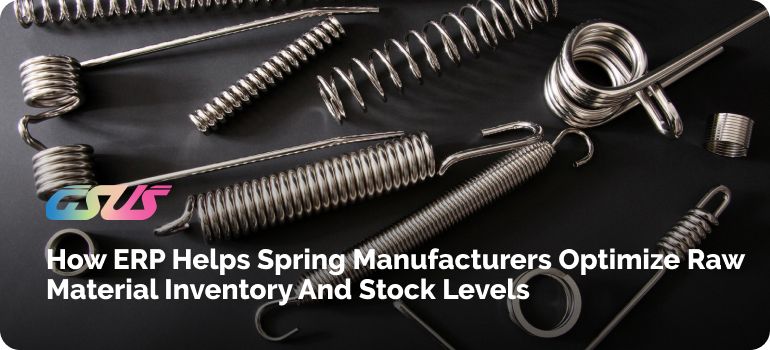
If you run a spring manufacturing unit, you already know that the real battle isn't on the shop floor - it's in the wire racks. A missing coil of the right diameter, a grade mix-up, or a purchase order that went out three days too late can stall an entire production run.
And when that happens, it's rare because the team wasn't working hard enough. It's usually because nobody had a clear, real-time picture of what was actually in stock.
This is where ERP for Spring Manufacturers starts to matter. Not as a buzzword, but as a practical fix for a problem that quietly eats into margins every single month: raw material inventory that nobody can fully trust.
Most spring manufacturers still manage inventory through a mix of spreadsheets, WhatsApp updates from the store, and gut feeling. It works fine when you're running a handful of SKUs. But the moment order volume grows, wire types multiply, and customers start asking for custom specifications; that system starts cracking.
Stock counts stop matching reality. Purchase decisions get made too late. And production ends up waiting on materials that "should have been" in the warehouse.
An integrated ERP like Odoo changes that by connecting inventory, purchasing, manufacturing, and sales into one system, so everyone - from the store manager to the production planner - is looking at the same numbers.
Why Raw Material Inventory Management Is Challenging for Spring Manufacturers
Spring manufacturing isn't like assembling a standard product off a single bill of materials. Raw material inventory management for spring manufacturers is genuinely more complicated because of a few industry-specific realities.
First, there's the sheer variety of spring wire - different materials, different grades, different diameters, each suited to a different application. A batch for an automotive customer might need a completely different specification than one going to an appliance manufacturer.
Add customer-specific material requirements on top, and your inventory list starts looking less like a simple stock register and more like a matrix.
Second, production schedules change often. Demand isn't always predictable, and when a large order comes unexpectedly, procurement must scramble. This is where inventory challenges in spring manufacturing really show up - you either run short on the exact wire spec you need, or you end up sitting on excess, slow-moving stock of a spec nobody's ordering right now.
Third, most of this is still tracked manually. Someone counts physical stock, updates a spreadsheet, and hopes it stays accurate until the next count. It rarely does.
Manual stock tracking is one of the most common causes of inventory management problems in manufacturing, simply because there's always a lag between what's written down and what's on the rack.
None of this is a people's problem. It's a systems problem - and it's exactly what Raw Material Inventory Management for spring manufacturers is supposed to solve when done right.
What Happens When Spring Manufacturers Don't Have Accurate Inventory Visibility?
Here's the chain reaction that plays out in a lot of spring manufacturing units, and it usually starts with one small thing: incorrect stock data.
Incorrect stock data leads to delayed purchase. Delayed purchasing leads to a material shortage. That shortage leads to a production delay. And the production delay, more often than not, ends in a missed delivery commitment - the one thing manufacturers really can't afford to lose repeat business over.
Without real-time inventory visibility, manufacturers end up firefighting instead of planning. Emergency purchases become routine, usually at a worse price because there's no time to negotiate or compare suppliers.
At the same time, overstocking creeps in on other materials because "better safe than sorry" becomes the default buying behavior. That ties up working capital in wire sitting on a shelf instead of putting it toward growth.
Production downtime is the most visible symptom, but the quieter cost is the excess working capital locked into inventory that isn't moving. Manufacturing inventory accuracy isn't just an operations issue - it's a cash flow issue, and business owners feel it even when they can't immediately point to the cause.
When Should a Spring Manufacturer Invest in ERP Inventory Management Software?
Not every manufacturer needs ERP inventory management software on day one. But there are some clear signs that spreadsheets have stopped serving you well:
- Inventory is still tracked through Excel, updated manually, and shared over email
- The warehouse team and the production team report different stock numbers for the same material
- Purchasing only happens after a shortage is already discovered
- Managers can't check current stock levels without calling someone or walking the floor
- Materials are hard to trace back to a specific supplier batch
- Excess inventory keeps quietly growing month over month
- Production regularly waits on materials that should have been ordered earlier
If two or three of this sound familiar, that's usually the point where a spring manufacturing ERP stops being a "nice to have" and starts being the thing standing between you and predictable production.
How ERP Software Improves Raw Material Inventory Management for Spring Manufacturers
The core idea behind ERP inventory management is simple: it connects the dots that used to live in separate files. Sales orders feed into production planning. Production planning determines material requirements.
Material requirements check against current inventory. Gaps trigger purchase suggestions. And purchase activity flows straight back into accounting.
When that chain is connected, a spring manufacturer isn't reacting to shortages anymore - they're seeing them coming weeks in advance.
8 Ways ERP Helps Optimize Raw Material Inventory in Spring Manufacturing
- Real-time raw material stock visibility. At any moment, you can see what's available, what's reserved for an existing order, what's incoming from a supplier, and what's already allocated to a work order - no phone calls needed.
- Automated Material Requirements Planning (MRP). Instead of someone manually calculating how much wire a production run needs, the system reads the bill of materials (BOM) and manufacturing orders and works it out automatically.
- Automatic reordering and minimum stock levels. Reorder points and minimum stock thresholds trigger purchase suggestions on their own, factoring in supplier lead times, so materials arrive before they're needed, not after.
- Material traceability and lot/batch tracking. Every coil of wire can be traced from the supplier lot it came from, through the warehouse, into the specific production run, and into the finished spring - useful for quality audits and customer complaints alike.
- Managing different wire types, grades, and specifications. Material type, diameter, grade, specification, and preferred supplier can all be tracked at a granular level, which matters enormously for custom spring manufacturing.
- Connecting inventory with production planning. A production order automatically checks material availability, flags shortages early, and routes the gap straight into procurement - rather than someone discovering the shortfall mid-run.
- Reducing excess and slow-moving inventory. With clear consumption data, purchasing decisions get sharper. Dead stock becomes visible instead of hiding in a back corner of the warehouse, and carrying costs start coming down.
- Inventory reporting and manufacturing analytics. Reports on current stock, low-stock materials, consumption trends, stock valuation, and slow-moving inventory give owners and managers something spreadsheets rarely can: a clear, current picture, on demand.
How Odoo ERP Manages Raw Material Inventory for Spring Manufacturers
This is where Odoo ERP for spring manufacturers earns its keep. Odoo brings Inventory, Manufacturing, Purchase, Sales, Quality, and Accounting into one connected platform, so inventory data isn't sitting in isolation from what's happening on the shop floor.
The core message here is straightforward: inventory shouldn't be treated as a separate function from production. In most spring manufacturing units we've worked with, the two are managed by different people using different tools - and that disconnect is exactly where shortages and overstocking quietly originate. Odoo closes that gap.
How Odoo Inventory and MRP Work Together for Spring Manufacturing
The workflow, in practice, looks something like this:
Customer Order → Manufacturing Order → BOM / Material Requirements → Inventory Availability Check → Purchase / Replenishment (if needed) → Production → Finished Goods
Every stage in that flow updates the next automatically. A sales order doesn't just sit in the sales module - it triggers a manufacturing order, which checks the bill of materials against current stock, and if there's a shortfall, generates a purchase request without anyone needing to chase it manually.
How ERP Helps Spring Manufacturers Prevent Material Shortages
Preventing shortages comes down to a handful of connected mechanisms: reorder points set at the right level, supplier lead times factored into every purchase suggestion, production demand feeding directly into procurement planning, and stock alerts that flag low inventory before it becomes a crisis.
Incoming inventory is visible now; a purchase order is confirmed, not just when the material physically arrives. Put together, this is what keeps production continuous and delivery commitments realistic.
ERP vs Excel for Raw Material Inventory Management
Excel isn't a bad tool - it's just the wrong tool once your operation grows past a certain size.
| Excel-Based Inventory | ERP-Based Inventory |
|---|---|
| Manual updates | Real-time updates |
| Separate files across teams | Centralized data |
| Manual reorder calculations | Automated replenishment |
| Limited traceability | Lot/batch traceability |
| Difficult to connect with production | Connected with MRP |
| Static, backward-looking reports | Real-time analytics |
This isn't about Excel being unfit for purpose - plenty of small operations run on it just fine. It's about recognizing the point where manual tracking starts costing more delays and errors than the ERP investment would.
How ERP Connects Raw Material Purchasing with Inventory and Production
A well-configured Manufacturing ERP Software ties procurement directly to production needs: Material Requirement → Purchase Request → RFQ → Purchase Order → Receipt → Quality Check → Inventory → Production.
This is one of the clearest reasons integrated ERP outperforms standalone inventory software - procurement isn't guessing what to buy; it's responding to actual, current demand.
How Better Inventory Management Can Reduce Manufacturing Costs
The cost impact of better raw material inventory management shows up in fairly predictable ways: fewer emergency purchases made at rushed prices, less capital tied up in excess stock, better utilization of the material you already have, lower inventory carrying costs, and less production downtime waiting on wire that should have already been ordered.
We won't throw out a specific percentage figure here - the real savings depend entirely on how your operation is running today - but the direction of the impact is consistent across manufacturers who make this shift.
How to Choose the Right ERP for a Spring Manufacturing Business
Before you commit to any manufacturing ERP software, it's worth checking it against a practical list:
- Can it manage raw materials down to the wire specification level?
- Does it support different material grades, diameters, and customer-specific requirements?
- Does it support BOMs properly?
- Is inventory connected with MRP, not siloed from it?
- Does it support lot/batch traceability?
- Can replenishment be automated based on reorder points?
- Does it give real-time stock visibility across locations?
- Does it integrate purchasing and accounting, not just inventory?
- Can it scale as production volume grows?
- Can workflows be customized to how your shop floor works, rather than forcing you into a generic template?
Is Odoo ERP Suitable for Small and Mid-Sized Spring Manufacturers?
Yes - and this is worth saying plainly because a lot of smaller manufacturers assume ERP Enterprise Systems are built only for large factories.
Odoo's modular approach means you can start with Inventory and Manufacturing, add Purchase and Quality as you grow, and expand into full enterprise ERP territory only when it makes sense for your business.
That said, ERP isn't magic on its own. The value comes from how well it's configured to match your actual production process - your BOMs, your material specs, and your reorder logic.
Implementation quality matters as much as the software itself, which is exactly why the setup phase deserves real attention rather than a rushed, generic rollout.
Common Raw Material Inventory Management Mistakes to Avoid
A few patterns show up again in spring manufacturing units, ERP or not:
- Buying materials only after stock has already run out
- Keeping excessive safety stock "just in case," which quietly ties up cash
- Ignoring supplier lead times when planning purchases
- Continuing to track materials manually even as order volume grows
- Overlooking slow-moving inventory until it becomes dead stock
- Running inventory and production as disconnected functions
- Weak or non-existent material traceability
- Relying on multiple disconnected systems instead of one source of truth
Fixing even two or three of these often makes a noticeable difference before any new software is even involved.
Build More Predictable Inventory and Production with Odoo ERP
Better inventory visibility leads to better material planning. Better material planning means fewer shortages. Fewer shortages mean smoother production. And smoother production is what actually protects your delivery performance - the thing your customers care about most.
That's the real case for ERP for spring manufacturers: it's not about adding complexity; it's about removing the guesswork that's currently costing you time, money, and trust with your customers.
As a Silver Partner with Odoo, GSUS works specifically with manufacturers who need their inventory, purchasing, production, and warehouse operations talking to each other - not just digitized, but connected.
Want to see how Odoo can connect your raw material inventory, purchasing, production, and warehouse operations? Talk to GSUS for an Odoo manufacturing assessment.