If you run a manufacturing business and you've started shopping around for new software, you've probably noticed the market splits into two camps.
On one side, all-in-one platforms like Odoo, where manufacturing sits next to sales, inventory, and accounting.
On the other, dedicated manufacturing systems are built to do one thing – run the shop floor – and do it deeply.
This isn't a small decision. Pick the wrong one, and you either pay for capability you'll never use, or stitch together three systems because the one you bought can't talk to finance.
The right call depends on your production complexity, growth pace, and how much you need everything connected under one roof.
This is exactly where a Manufacturing ERP earns its name - not by being the flashiest tool on the floor, but by quietly holding production, inventory, purchasing, and accounting together so nobody's working off an outdated spreadsheet.
Odoo has become a talked-about option here, mostly because it tries to be the "one platform" answer rather than a bolt-on. Let's break down where that works and where it doesn't.
What Is a Manufacturing ERP and What Does It Need to Handle?
A Manufacturing ERP Software isn't just software that tracks what you're building. It's the layer connecting your production floor to everything else - sales orders that trigger manufacturing orders, inventory that updates as components get consumed, costing that flows straight into your books.
- At minimum, proper Manufacturing Management Software needs to handle:
- Production planning and scheduling — what needs building, by when, in what order
- Bill of Materials (BOM) and manufacturing orders — the recipe and the instruction
- Work centers and shop-floor operations — where the building happens
- Inventory and procurement integration — materials showing up before you run out
- Quality and maintenance management — catching problems before they get expensive
- Costing, accounting, sales, and purchasing integration — so production numbers mean something to finance
Miss any of these and you get gaps - a system that looks good on paper but leaves someone re-entering data manually every afternoon. The real test of any manufacturing operations tool: does it remove manual work, or just relocate it?
How Odoo Manufacturing Approaches Production Management
Odoo's manufacturing module - often called Odoo MRP - takes the connected-platform approach seriously, sitting inside the same database as sales, inventory, purchasing, and accounting.
Manufacturing orders and BOM management. Build multi-level Bills of Materials, attach routing steps, and generate manufacturing orders automatically from sales demand or reorder rules.
Work centers and work orders. Define work centers, assign operations, track time, and see where a job actually sits in the queue.
Production planning and scheduling. A visual, Gantt-style planning view lets planners see capacity and reschedule as priorities shift.
Inventory and warehouse integration. Arguably Odoo's strongest card - component consumption and finished goods receipts update in real time, no separate sync job needed.
Quality, maintenance, and PLM integration. Additional modules bring quality checkpoints, preventive maintenance, and product lifecycle management.
Real-time visibility. Dashboards pull live shop-floor data into reports finance and operations can both read.
For a business that wants Odoo BOM management, work orders, and inventory living in one place instead of three, this is a genuinely strong setup. But "strong" doesn't mean "unlimited."
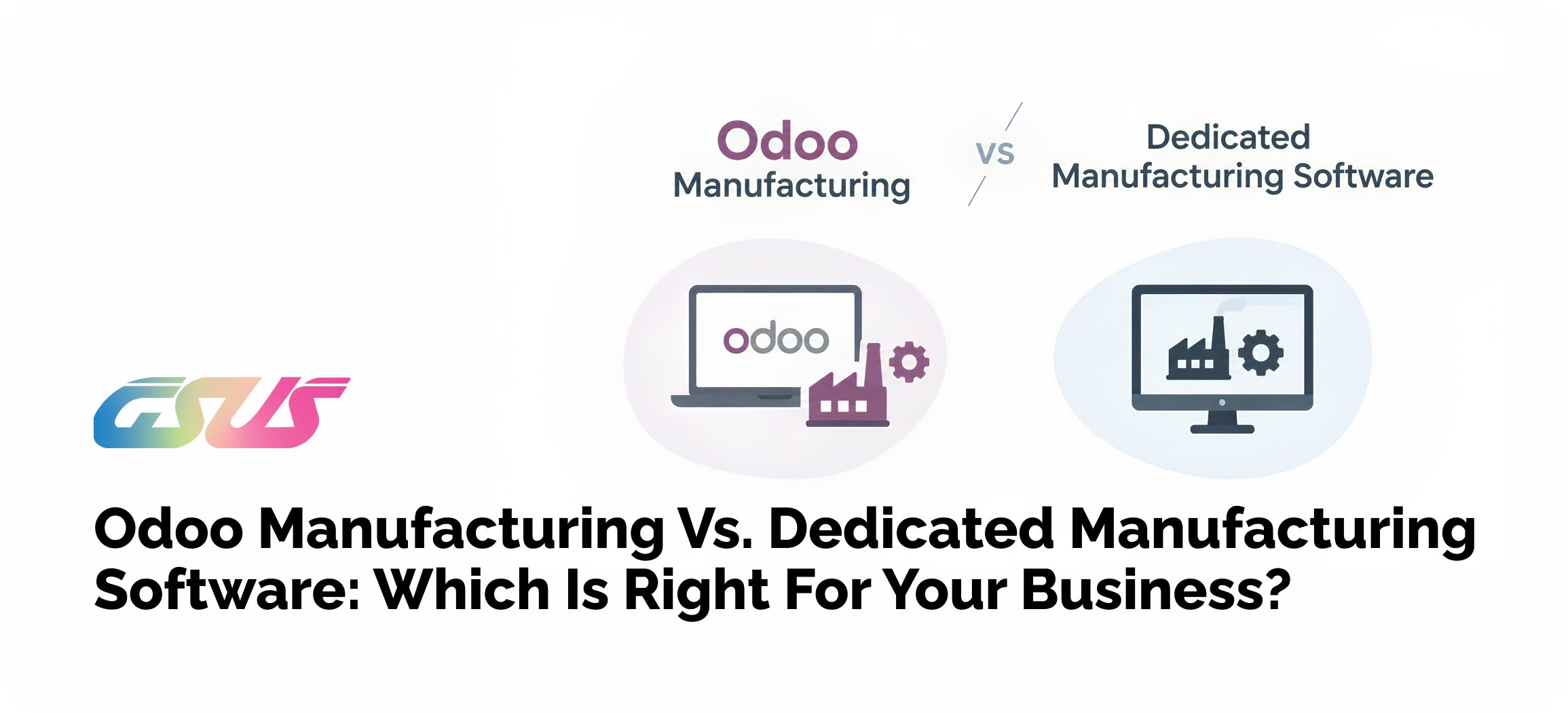
Odoo Manufacturing vs. Dedicated Manufacturing Software: Where Is the Real Difference?
Manufacturing Depth and Production Complexity
Odoo handles standard manufacturing - make-to-stock, make-to-order, kitting, light assembly, multi-level BOMs - comfortably. It strains with highly specialised operations: complex routing with many conditional branches, process manufacturing with tight formula controls, or batches needing machine-level parameter logging. Dedicated systems built for a specific vertical often start closer to that finish line.
Shop-Floor Control and Real-Time Production Visibility
Dedicated systems, especially paired with a Manufacturing Execution System, often give machine-and-operator-level visibility: exact cycle times, automatic downtime logging, per-shift productivity.
Odoo's shop-floor management gives solid work center and barcode-based tracking, but isn't built for that same granularity out of the box.
Production Planning and Scheduling
Both support demand-driven and capacity planning, but dedicated tools often push further with finite scheduling that accounts for machine constraints in real time. Odoo's production scheduling handles changing priorities well for most manufacturers, without the constraint-based optimisation of specialised planning engines.
Quality, Traceability, and Compliance
Lot and serial number traceability, inspection workflows, and non-conformance management are all available in Odoo and cover a lot of ground. Industries with strict, audited compliance requirements - food safety, medical devices, regulated chemicals - sometimes need traceability depth only a purpose-built system was designed for.
When Does Odoo Manufacturing Make More Sense Than a Dedicated System?
Odoo tends to fit better when you want manufacturing connected to finance, sales, inventory, purchasing, and CRM rather than living in its own silo; when you're replacing spreadsheets or a legacy system nobody trusts; or when you want a scalable Enterprise ERP approach rather than a tool you'll outgrow in two years.
This is really the sweet spot for Integrated ERP for manufacturing - businesses that value end-to-end manufacturing management and business process automation over one single feature being best-in-class. If manufacturing digital transformation is the goal, Odoo's ERP integration usually wins on total value.
When Might a Dedicated Manufacturing System Be the Better Choice?
A dedicated system makes more sense when production is extremely specialised and standard MRP logic doesn't map well, when you need advanced machine-level tracking, or when you already run a strong ERP for finance and just need a specialised manufacturing layer.
The Importance of MES, Machine Integration, and Advanced Production Control
If your priority is a Manufacturing Execution System, IoT and machine connectivity, real-time production data straight off the equipment, or automated shop-floor data collection, that's a different conversation.
These systems sit close to the machines by design. Odoo can integrate with MES and machine data through APIs, but it isn't trying to replace a dedicated MES - and it shouldn't have to.
Can Odoo Be Customized for Complex Manufacturing Requirements?
Yes - manufacturers often underestimate what's possible. Odoo customisation can extend to custom workflows and approval processes, custom production screens and reports, integration with machines and legacy systems through APIs, and industry-specific requirements built as modules rather than workarounds.
Odoo development is flexible because the platform is open by design. Still, there's a line where standard functionality ends and real Odoo customisation begins. When standard workflows genuinely aren't enough, Custom ERP Software built around Odoo's framework is often smarter than abandoning the platform altogether.
Manufacturing ERP vs. Custom ERP Software: Which Approach Fits?
There are really three routes: a standard ERP implementation using out-of-the-box features, Odoo with configuration and customisation layered on top, or a fully Custom ERP built from scratch. Each carries different cost, flexibility, and maintenance trade-offs - and most manufacturers overestimate how much custom development they actually need.
When Should Manufacturers Consider a Custom ERP?
A fully custom build makes sense with genuinely unique production processes, complex approval chains no standard software maps to, deep existing-system integration needs, or industry-specific functionality nothing off-the-shelf covers. Outside those situations, custom development for its own sake usually just adds cost and risk.
How Odoo Implementation Determines the Success of a Manufacturing ERP
Software capability alone doesn't guarantee a successful rollout. Most failed Odoo Manufacturing Implementation projects don't fail because the platform lacks features, they fail because steps got skipped.
A proper Odoo implementation for manufacturing means mapping current processes before touching the software, identifying operational gaps honestly, configuring Odoo around how the business actually works, careful data migration and system integration, real user training, and post-implementation support. Skip any of these and even the best Odoo ERP implementation services can't save the project.
Why Choosing the Right Odoo Implementation Partner Matters
Anyone can install Odoo. Not everyone understands manufacturing well enough to configure it properly.
A good Odoo Implementation Partner assesses whether standard functionality meets your requirements, identifies when customisation is genuinely necessary, integrates Odoo with existing systems without creating new silos, and plans for growth.
At GSUS, this is exactly the gap we work in as an Odoo Silver Partner. We've sat across the table from manufacturers whose DIY implementation technically worked but never matched how their shop floor actually operated.
Our Odoo consulting approach starts with understanding the manufacturing process itself, not just installing modules - usually the real difference between an ERP that gets adopted and one that quietly gets abandoned.
If you're evaluating Odoo ERP consultant options, ask any partner how they handle manufacturing-specific configuration, their integration approach, and their post-launch support - that's usually where projects quietly succeed or stall.
A Practical Checklist for Evaluating Odoo Manufacturing vs. a Dedicated System
Production Complexity: Can the system handle your actual manufacturing processes, workflows, and production requirements?
Planning: Can production be planned effectively based on demand, capacity, and available resources?
BOM & Routing: Can it manage complex Bills of Materials, product structures, and manufacturing routes?
Shop Floor: Does it provide the level of real-time production visibility and shop-floor control your business needs?
Quality: Can it support quality checks, traceability, inspections, and other quality requirements?
Inventory: Is inventory directly connected with manufacturing, purchasing, and production activities?
Integration: Can it connect with your existing business systems, machines, equipment, or third-party applications?
Customisation: Can specific functionality gaps be addressed through configuration or custom development without creating excessive complexity?
Scalability: Can the system support increasing production volumes, users, locations, and business operations as the company grows?
Total Cost: What will be the overall cost of implementation, customisation, licensing, integration, maintenance, and future upgrades?
Odoo Manufacturing or Dedicated Software: A Decision Framework
Choose Odoo when:
Integration across business functions is a priority, standard manufacturing capabilities cover most of what you need, you want a single ERP platform, customisation can close remaining gaps, and scalability and total cost matter as much as individual features.
Consider a dedicated system when:
Manufacturing requirements are extremely specialised, advanced shop-floor capabilities are essential, your existing ERP already handles finance well, or deep MES/machine-level functionality is the primary requirement.
The Bottom Line: Is Odoo Manufacturing Deep Enough for Your Business?
There's no universal answer, and anyone who gives you one without asking about your actual workflows is guessing.
Evaluate what your production process really requires rather than comparing feature checklists, and factor in integration needs, complexity, scalability, and where the business is headed.
For growing manufacturers, Odoo can be positioned as a genuine Enterprise ERP option, where manufacturing works alongside finance, sales, and inventory instead of sitting in its own corner.
For others with deeply specialised production, a dedicated system paired with a well-integrated ERP might still be the smarter bet. Either way, a proper process assessment should come before the decision, not after the contract is signed.
Not sure whether Odoo Manufacturing fits your production process, or whether you need something more specialised? GSUS, an Odoo Silver Partner, offers manufacturing workflow assessments to help you make that call with real data instead of guesswork. Get in touch to start the conversation.