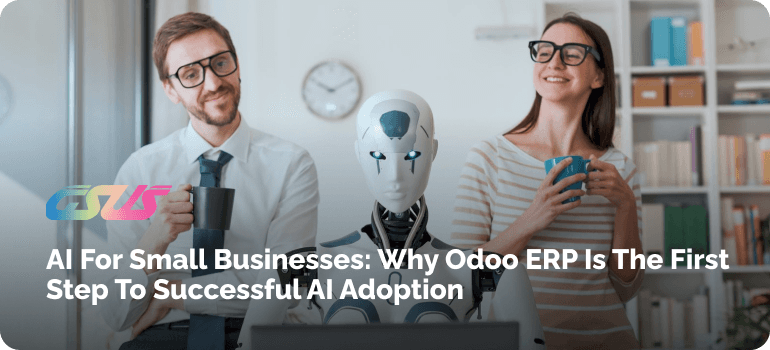
Every other week, there's a new headline about how AI is about to change the way small businesses operate.
And honestly, a lot of that hype is true. From chatbots that handle customer queries to tools that forecast demand before you even ask, AI for small businesses is no longer some far-off concept reserved for big enterprises with fat budgets. It's here, it's accessible, and it's genuinely useful.
But here's the part most headlines skip: AI doesn't work well on messy data.
If your sales figures live in one Excel sheet, your inventory in another, and your customer details in someone's inbox, no amount of AI adoption is going to fix that. It'll just automate chaos faster.
That's where a Small Business ERP like Odoo comes in. Before you can meaningfully use AI, you need one clean, connected source of business data.
Odoo ERP brings your sales, inventory, accounting, HR, and customer information into a single system, which is exactly the foundation AI needs to actually deliver value.
Think of it as a separate step and more as the groundwork that makes real business process automation possible.
In this blog, we'll look at why SMEs are rushing toward AI, the mistakes that trip most of them up, and why Odoo ERP is the sensible first move before you spend on AI tools.
Why AI for Small Businesses Is Growing Faster Than Ever
A few years ago, AI adoption for small businesses felt like a luxury. Today, it feels closer to a necessity, and there are some very real reasons why.
Market trends are shifting fast. Customers expect quick responses, personalized recommendations, and services that feel tailored to them, not generic. If a small business can't keep up, a competitor down the street usually can.
That competitive pressure has pushed owners to look seriously at AI solutions for SMEs, even ones who never considered themselves "tech people." This is part of why AI for small businesses keeps coming up in boardroom and kitchen-table conversations alike.
Then there's a productivity angle. Small teams wear a lot of hats. Owners juggle sales calls, chasing invoices, managing stock, and planning for growth, often in the same afternoon.
The benefits of AI for small businesses show up here: automating repetitive tasks, flagging issues early, and freeing up hours that used to go into manual data entry.
Add the falling cost of cloud tools and AI services, and it's easy to see why AI adoption for small businesses has picked up so quickly.
It's not hype anymore. Its owners realize they can do more with the same size team, if the right systems are in place.
The Biggest Mistake Small Businesses Make Before Adopting AI
Here's where most businesses go wrong, and it has nothing to do with picking up the "wrong" AI tool.
The real problem is what's happening behind the scenes. Scattered Excel files. One spreadsheet for sales, another expenses; a third someone made last quarter and forgot to update.
Manual processes that depend on one employee remembering to send an email or update a number. Duplicate data sitting in three places, each slightly different from the others.
This is one of the most common AI adoptions mistakes we see: businesses bolt AI onto a system that doesn't have consistent, centralized information to begin with.
AI thrives on structured, reliable data. Feed it inconsistent numbers, and it'll happily give you inconsistent, sometimes flat-out wrong predictions.
AI readiness for small businesses isn't about buying the fanciest AI subscription. It's about business data management first.
If your team can't pull an accurate sales report in under five minutes, adding AI on top won't solve the underlying issue; it'll just make the mess move faster.
Why Odoo ERP Is the Foundation for AI-Ready Small Businesses
This is where Odoo ERP earns its place in the conversation. Odoo isn't just accounting software or just a CRM.
It's a genuinely integrated business management platform where Sales, CRM, Inventory, Manufacturing, Purchase, Accounting, and HR all live inside one connected system.
What that means practically is this: when a sales order is created, inventory updates automatically.
When a customer interaction happens in CRM, that history is visible to support and sales without anyone forwarding an email. When an invoice is raised, it reflects in accounting instantly, no manual re-entry required.
For a business trying to become an AI-ready ERP user, this connected structure matters more than people realize. AI models need context. They need to see how sales relate to inventory, how inventory relates to purchase cycles, and how all that ties back to financial performance. Odoo ERP for small businesses gives that context automatically, because everything is already talking to everything else.
This is also why we recommend Odoo ERP as the starting point for ERP for AI adoption conversations. You're not stitching together data from five disconnected tools. You're working from one clean, reliable source of truth.
How Odoo ERP Helps Small Businesses Prepare for AI Adoption
Let's get a bit more specific about what this preparation actually looks like day to day.
With centralized business data, every department pulls numbers from the same place. No more "my report says one thing, yours says another" arguments in the Monday meeting.
Real-time dashboards mean owners and managers see what's happening right now, not what happened two weeks ago when someone finally updated the spreadsheet.
Automated workflows reduce the manual back-and-forth that eats so much time in small teams. Approvals, reorder alerts, follow-up reminders; these can all run in the background instead of relying on someone remembering to do them.
And because Odoo ERP AI integration is built into the platform's roadmap, businesses using Odoo are naturally positioned to plug in AI-powered ERP software capabilities as they roll out, whether that's smarter forecasting, automated reporting, or predictive insights.
You're not retrofitting AI into a rigid old system; you're building a platform designed to evolve with it.
Better reporting, an AI-ready database, and workflows that don't rely on manual memory, that's the real preparation work most businesses skip.
7 Ways Odoo ERP Supports AI for Small Businesses
Automates Repetitive Business Processes
Invoice generation, stock reordering, follow-up emails, and approval chains. Odoo handles the repetitive stuff, so your team can focus on decisions that actually need a human.
Provides Real-Time Business Insights
Instead of waiting month-end reports, owners get live dashboards showing sales performance, cash flow, and stock levels as they happen.
Improves Inventory Accuracy
Manual stock counts are notorious for errors. Odoo's inventory module tracks movement automatically across warehouses, reducing overstocking and stockouts.
Supports Smarter Decision-Making
When your data is accurate and centralized, decisions stop being guesswork. You're reacting to real numbers, not gut feeling or outdated spreadsheets.
Enhances Customer Relationship Management
Every customer interaction, quote, and support ticket lives in one CRM record, so your team always has the full picture before reaching out.
Improves Financial Visibility
Accounting syncs directly with sales and purchase data, giving a clearer, real-time view of profitability instead of a monthly scramble to reconcile numbers.
Scales as Your Business Grows
Odoo's modular structure means you add what you need, when you need it, a new warehouse, a manufacturing module, or an extra sales team, without rebuilding your whole system.
Signs Your Small Business Is Ready for AI
Not sure if your business is ready to explore AI tools? Here's a quick AI readiness checklist:
- Business data is centralized in one system, not scattered across files and inboxes
- Manual work has been reduced through automation, not just tolerated as "how we've always done it"
- Teams across departments use one connected system, not five different tools that don't talk to each other
- Reports are accurate and available on demand, not reconstructed manually every month
- Processes are standardized, so the same task is done the same way regardless of who's doing it
If most of these boxes are still unchecked, that's not a failure; it's simply a sign of where to start.
This is exactly the digital transformation for SMEs for groundwork that makes an eventual AI strategy for small businesses to pay off, instead of becoming another expensive tool nobody uses.
How AI and Odoo ERP Work Together
A lot of business owners worry that AI means replacing their team. In practice, that's rarely how it plays out in a well-run SME.
AI and ERP integration work best as a support layer, not a replacement.
Once your data lives inside Odoo ERP, AI can start forecasting demand based on historical sales patterns, generating reports without someone manually building pivot tables, suggesting workflow improvements where bottlenecks keep showing up, surfacing customer insights that would take a human hours to spot manually, and predicting inventory needs before a stockout happens.
The key point with AI in ERP software is that none of this works in isolation. The AI is only as good as the data flowing into it, and that data quality comes directly from having a properly implemented, centralized ERP system.
Odoo AI capabilities are meaningful precisely because Odoo already organizes your business information in a way AI models can actually use.
Why Growing Businesses Choose Odoo ERP for Digital Transformation
There are plenty of ERP options out there, so it's fair to ask why Odoo specifically comes up so often in digital transformation with Odoo conversations.
Part of it is cost. Odoo's modular approach means businesses aren't forced into an expensive, all-or-nothing implementation.
You start with what you need, whether that's just accounting and inventory, and expand as you grow.
Cloud deployment also matters for SMEs. There's no need for expensive on-premises servers or a dedicated IT team just to keep things running.
Combine that with genuine scalability, easy customization for industry-specific needs, and a gentler learning curve than many legacy ERP systems, and it's easy to see why ERP for business growth discussions so often land on Odoo. It's built for businesses that plan to grow, not stay the same size forever.
How GSUS Helps Small Businesses Become AI-Ready with Odoo ERP
This is exactly the kind of work we do at GSUS. As a Silver Partner with Odoo, we've spent years helping small and mid-sized businesses move away from scattered spreadsheets and disconnected tools toward one properly implemented Odoo ERP for small businesses.
Our process usually starts with an honest business consultation, understanding how your operations run today before recommending anything.
From there, we handle Odoo implementation and customization based on your industry, whether that's retail, manufacturing, services, or distribution, so the system fits how you work, not the other way around.
We also don't disappear after we live. Training your team and providing ongoing support matter just as much as the implementation itself, because an ERP system only delivers value if people use it correctly.
And as your data matures inside Odoo, we help build an AI readiness strategy so that when you're ready for AI-powered ERP software, you're building a foundation that's already solid.
Conclusion
AI doesn't create business success on its own. It amplifies whatever foundation you already have, good or bad.
A business running on scattered spreadsheets will get scattered, unreliable AI results. A business with organized processes, centralized data, and a properly integrated ERP will get genuinely useful insights and automation that saves time.
That's the core message here: before chasing the latest AI tool, take an honest look at how your business data is organized today. If it's messy, that's the real starting point, not the AI itself.
If you're serious about AI adoption but not sure where your business stands, take a proper look at your existing systems first.
Reach out to GSUS for an Odoo ERP consultation, and let's figure out your first step toward becoming a genuine AI-ready business.