Here's something odd about most factories today. They've spent years on digital transformation, dashboards, sensors, and automated reports flying around.
Yet ask a shift supervisor how they tell the warehouse a batch just ran short on raw material, and the honest answer is often a walkie-talkie, a shout across the line, or a sticky note on someone's monitor.
That's the gap nobody talks about enough. Plants keep buying software, but the way people actually talk to each other on the floor hasn't really moved on.
A machine fault that takes two hours to get logged. A shift handover where half the important stuff never makes it past a scribbled note. A stock count that someone just says out loud, and nobody writes down properly.
None of this feels like a big deal in the moment, but add it up over a month, and you start to see real dents in production output, maintenance planning, quality records, and inventory accuracy.
This is really where Manufacturing ERP Software needs to catch up. Storing data and spitting out reports used to be enough; it isn't anymore. Factory systems now need to help people communicate faster, with less friction, right where the work is happening.
Voice AI is one of the more interesting ways this is playing out, and we'll get into why factory communication keeps breaking down, how voice technology fixes it, and how a platform like Odoo ERP makes this a realistic upgrade without ripping out everything you've already built.
What Is Manufacturing ERP Software and Why Does Factory Communication Matter?
At the most basic level, a Manufacturing ERP pulls everything on a production floor into one place, purchasing, inventory, production orders, quality checks, maintenance, finance.
Decent Factory Management Software replaces the pile of spreadsheets and half-connected tools plants still limp along on.
All of it hinges on one thing working properly, information moving between people and the system, accurately and on time. A Production Management System is only as good as what gets fed into it.
If an operator spots a defect and doesn't log it for two hours, quality control is working off old news. If someone updates stock counts at the end of the day instead of when it changes, purchasing ends up guessing.
So, communication on the floor isn't a soft, nice-to-have topic; it's operational.
A shift handover, a maintenance ticket, a quick note about a defect are all communication events first, data points second. If communication doesn't happen cleanly, the data never shows up either.
The Hidden Communication Challenges in Modern Manufacturing
Most manufacturers underestimate how much money quietly leaks out through small communication gaps: delayed production updates, since operators are busy running machines and typing something in tends to get pushed to "I'll do it later", which has a way of becoming never; paper that just won't die, like a clipboard tracking downtime that gets transcribed hours later, if at all; shift handovers where the outgoing crew knows exactly what happened but the incoming crew only knows what got written down clearly; maintenance reporting delays, where a technician hears something off but doesn't file anything until the scheduled walk-around, by which point it's turned into unplanned downtime; inventory misunderstandings from a verbal count that leaves the system and the shelf disagreeing; and manual data entry itself, which is simply error-prone, every hand-typed number is a chance to get it wrong.
None of these looks dramatic in isolation. But stretch them across a shift, a week, a quarter, and they quietly drag down output.
Shop floor communication problems rarely show up as one big crisis; they show up as a slow leak that's hard to trace back to its source.
Why Voice AI Is Becoming Essential for Manufacturing ERP Software
For years, ERP software basically assumed someone would sit down, open a screen, and type.
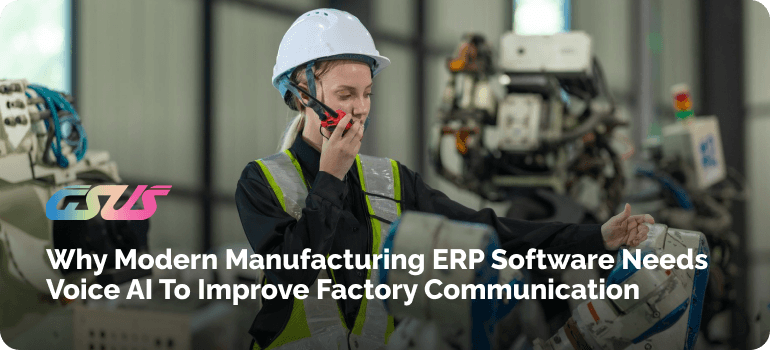
Makes sense on paper, makes far less sense on a factory floor, where hands are full, noise is high, and nobody's standing still long enough to fill out a form. Voice AI breaks that old assumption.
Instead of stopping to log something, an operator can just say it out loud, "Line 3 machine down, hydraulic issue", and have it picked up, transcribed, and routed automatically.
That's the shift underway in AI in Manufacturing: moving away from manual typing toward voice-driven workflows that match how people work.
What that gets you in practice: hands-free reporting, so nobody has to down tools to log an update; faster reporting, since issues get flagged the moment they happen; real-time information, so the ERP reflects what's going on right now, not three hours ago; and a workforce that spends less time on admin and more time on the job.
This is what a Voice-enabled ERP really means, not a flashy add-on, but a more natural way for the people running the factory to stay in sync with the system meant to support them.
Smart Manufacturing gets talked about in terms of robots and sensors, but a big part of it is just making sure the humans in the loop can keep up.
How Voice AI Works Inside Odoo Manufacturing ERP
Odoo ERP happens to be a good fit for this because of how open its structure is. The Odoo Manufacturing Module already handles production orders, work centers, bills of materials, and quality checkpoints.
Adding Voice AI on top doesn't mean tearing any of that down; it means building onto it, voice commands letting someone pull up a work order just by asking, logging a quantity or defect note by speaking instead of typing, speech-to-text turning a spoken comment into an actual structured record, and the AI triggering real actions like opening a maintenance ticket based on what was said.
That plugs directly into the parts of the system that matter most day to day: production orders update as the work happens, inventory shifts as materials move, maintenance requests get filed the second someone notices a problem, and quality inspections get recorded without anyone walking back to a terminal first.
Key Benefits of Voice AI in Manufacturing ERP Software
Faster shop floor communication tops the list; information gets from the person who has it to the system that needs it in seconds, not hours.
Production updates happen in real time, so supervisors see what's actually happening on the line, not a stale summary from hours back.
Productivity naturally improves once people aren't burning time on manual logging. Manual entry drops, and with it, the typos and skipped fields that come from typing under pressure.
Inventory accuracy improves because stock updates the moment it changes, not at the end of a shift when nobody quite remembers the number.
Maintenance reporting speeds up, catching small mechanical issues before they turn into expensive breakdowns.
Quality control gets sharper because defects get logged in the instant they're spotted.
And decision-making improves across the board, simply because managers are working with what's true right now, not what was true yesterday.
Real-World Manufacturing Scenarios Where Voice AI Makes a Difference
Picture a Production Supervisor spotting a bottleneck and just saying so out loud instead of hunting down a terminal.
A Warehouse Operator unloads delivery, hands full, confirming quantities by voice rather than stopping typing.
A Maintenance Engineer on rounds logging a strange noise the moment it's heard, instead of waiting for the walk-around to end.
A Quality Inspector flagging a defect the second it's found, so the record matches the moment it happened.
A Plant Manager wrapping up the day asking the system directly for output, downtime, and pending maintenance instead of pulling three separate reports.
Different roles, same idea: manufacturing automation works best when it takes friction out of the human side of things, not just the mechanical side.
Why Odoo ERP Is an Ideal Platform for Voice AI Integration
Not every ERP handles this kind of upgrade gracefully. Odoo's modular setup means voice features can be dropped into specific areas, manufacturing, inventory, maintenance, without disturbing everything else.
Its API integration makes connecting speech-to-text and AI services fairly straightforward, and it's genuinely built to extend rather than resist new tech.
Mobile accessibility means voice features work from a handheld device on the actual floor, and workflows can be customized to match how your specific plant runs, scaling from one production line to several sites without a full rebuild.
Compared to a lot of rigid legacy platforms, it's genuinely cost-effective too.
As a Silver Partner with Odoo, GSUS has worked with manufacturers chasing exactly this kind of upgrade, something flexible enough to grow alongside voice AI, instead of a system that quietly ages out in a few years.
Features Every Manufacturing ERP Should Have for Voice AI
Worth checking your current system against this list before assuming it's ready: voice-enabled data entry, AI-powered workflows, mobile accessibility, real-time dashboards, production tracking, inventory management, maintenance management, quality management, multi-language voice support, and solid user authentication.
Best Practices for Implementing Voice AI in Manufacturing ERP Systems
Don't flip this overnight; rushing it tends to backfire. Start by figuring out where communication delays are costing you money, then pick out the repetitive tasks that are easiest to automate first.
Train people properly, so the tool feels like a genuine help rather than one more thing to learn under pressure.
Roll it out in one department first; the warehouse or maintenance team are good candidates, before spreading it further.
Track a few real KPIs, like reporting time or data accuracy, then scale gradually while keeping an eye on whether people are actually using it, because even a good tool fails quietly if it just gets ignored.
The Future of Manufacturing ERP Software with Voice AI and Artificial Intelligence
This is still early. As Industry 4.0 keeps moving forward, it's not hard to imagine conversational ERP Systems where a worker just asks, "What's our downtime on Line 2 this week?" instead of digging through a report.
AI assistants will likely shift from simply logging things to spotting patterns through voice analytics a person might miss, paired with predictive insights that catch maintenance or quality problems before they cause real damage.
Some routine steps will become fully autonomous, while judgment calls to stay with people, working alongside the AI rather than being replaced by it.
Why Businesses Should Adopt Voice AI with Odoo ERP Today
The case for this is pretty straightforward once you look at it plainly: faster communication across departments, better operational efficiency, lower costs from fewer errors and less downtime, and a better experience for employees who'd rather not stop mid-task to fill out a form.
In a competitive manufacturing market, catching problems sooner and reporting more accurately is a real edge, not just a talking point.
This is where the right customization matters. An off-the-shelf system rarely fits any factory's workflow perfectly.
Odoo's flexibility, paired with the right implementation partner, makes it realistic to build a voice-enabled setup around how your plant runs, not the other way around.
Conclusion
Manufacturing communication is turning into a genuine competitive edge. Factories closing the gap between what's happening on the floor and what's recorded in the system are the ones catching problems earlier and making sharper decisions.
Voice AI isn't here to replace your workforce; it's here to take the friction out of manual data entry and give people a faster way to keep the system honest.
Modern Manufacturing ERP Software should make communication faster, hands-free, and more accurate, right at the point where the work happens.
Odoo ERP gives businesses a genuinely flexible base to build that on, and as an Odoo Silver Partner, GSUS works with manufacturers to shape that next step around their real workflows, not a generic template.
If you're not sure whether your current ERP is ready for the next stage of factory communication, it's worth taking a proper look before that gap gets any wider.