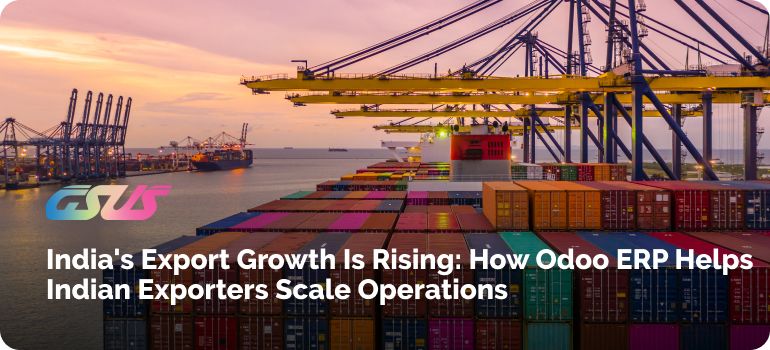
If you've been following India's trade numbers lately, you've probably noticed the headlines have been upbeat. And for once, the data actually backs up.
Between April and August of FY 2026-27, India's combined merchandise and services exports touched US$399.27 billion (about $1,200 per person in the US), up from US$345.55 billion (about $1,100 per person in the US) in the same period a year earlier - a growth rate of roughly 15.55%.
Worth clarifying here: that US$399.27 billion (about $1,200 per person in the US) figure is the combined merchandise plus services number, not merchandise exports alone, and the services portion for August is still partly an estimate.
Merchandise exports on their own came in at US$215.91 billion (about $660 per person in the US), growing at an even sharper 17.85%.
What's driving this? A mix of sectors, really - electronic goods, petroleum products, engineering goods, organic and inorganic chemicals, and cotton yarn, fabrics, made-ups and handloom products all contributed to August's merchandise export growth.
Now, does this mean every exporter in the country suddenly needs an ERP System? No, that's not a fair claim to make.
But it does mean something quieter and more practical: when export activity climbs, the operational load behind the scenes climbs with it. And that's really what this article is about.
What Does Export Growth Mean for Indian Exporters and Manufacturers?
Numbers on a government dashboard are one thing. What they actually translate to on the shop floor is another.
More export orders usually mean more customer orders to track, higher production requirements to plan around, and increased raw-material procurement to stay ahead of.
It means more inventory movement across warehouses, more shipments going out the door, and more invoices and receivables to reconcile - often across different currencies and different international customers with different expectations.
It also means something that doesn't show up in any export statistics: greater coordination between sales, production, the warehouse, and finance.
When one order moves through four or five departments before it's fulfilled, the question stops being "can we grow" and becomes "can we grow without losing track of things."
This is the real story behind export growth in India right now - not just bigger numbers, but bigger operational complexity sitting quietly underneath them.
Why Export Businesses Struggle to Scale with Disconnected Systems
Talk to almost any mid-sized Indian exporter and you'll hear some version of the same story. Orders come in through email. Quotations get built in Excel. Accounting runs on separate software. Production updates travel over WhatsApp. Warehouse records live in a register or a spreadsheet nobody quite trusts.
Individually, none of these tools are bad. Together, they create real problems.
The sales team often doesn't have real-time visibility into stock, so they end up promising delivery dates they can't confirm. Production doesn't always know which orders are the actual priority for the week.
The purchase team is guessing upcoming material requirements instead of working from a clear plan. Finance is tracking invoices in its own silo, disconnected from what's shipped. And shipment status? Good luck getting a straight answer without a phone call to three different people.
The result is that management spends a disproportionate amount of time just collecting information from scattered systems, instead of acting on them. That's the real cost of disconnected workflows - not one big failure, but a hundred small delays that add up.
Where Export Businesses Need Better Operational Visibility
Let's break this down into the areas where the gaps usually show up first.
Export Order Management and Customer Order Tracking
Every export order moves through a predictable path - quotation, sales order, delivery, and invoice. The trouble starts when each of these stages' lives in a different tool.
Odoo Sales supports this entire flow from quotation through to sales order, delivery, and invoicing, and it also allows foreign-currency pricing to be configured for international customers.
That alone removes a surprising amount of back-and-forth for teams handling export order management software needs manually.
Export Inventory Management Across Warehouses
Exporters are usually juggling several categories of stock at once - raw materials, finished goods, reserved stock, incoming stock, outgoing stock, and goods that are technically in transit.
Add multiple warehouse locations into that mix, and manual tracking gets messy fast. Odoo Inventory handles warehouse and location management along with stock movement tracking, and its reporting shows on-hand, incoming, and outgoing quantities in one place - which is exactly where Export Inventory Management tends to fall apart in spreadsheet-based setups.
Production Planning for Manufacturing Exporters
This one is especially relevant if you're in engineering, textiles, automotive components, or chemicals - basically any manufacturing exporter working on a make-to-order or make-to-stock model.
The typical flow looks like this: export order comes in, material requirement gets calculated, purchase happens, production runs, quality checks follow, finished goods get created, and then delivery.
When these steps aren't connected, delays creep in at every handoff. This is where ERP for Manufacturing Exporters in India genuinely earns its place.
Export Costing and Profit Visibility
Knowing your product cost, material cost, manufacturing cost, packaging, and logistics-related expenses - and how they stack up against your selling price - is what tells you whether an export order is actually profitable.
To be fair, this isn't something that happens automatically just because you install software; it depends entirely on how the costing workflow is configured.
But when it's set up properly, export costing software for manufacturers gives you margin visibility; you simply can't get disconnected records.
Multi-Currency Sales and Export Accounting
Export businesses deal with foreign-currency transactions as a matter of course - different currency rates, receivables, payments, and the inevitable exchange-rate differences that show up along the way.
Odoo Accounting supports additional currencies and currency-rate configuration, including handling exchange-rate differences, which makes Odoo multi-currency accounting for export businesses considerably less painful than reconciling everything manually.
How Odoo ERP Connects the Export Order-to-Payment Cycle
Here's where the pieces come together. A typical export cycle looks like this: customer enquiry → quotation → sales order → inventory check → purchase or manufacturing → quality and finished goods → warehouse and delivery → invoice → payment and accounting.
The value of Odoo ERP for Export Businesses isn't any single feature in that chain - it's that Sales, Inventory, Manufacturing, and Accounting can function as connected parts of one workflow rather than separate systems that need to be manually reconciled at the end of each week.
The exact process still depends on how it's implemented and configured for your business, but the underlying idea is straightforward: fewer handoffs, fewer gaps, fewer surprises.
How Odoo ERP Helps Indian Exporters Manage International Sales
For businesses focused specifically on international sales, a few things matter most - managing customers and international sales orders in one place, handling multiple currencies without manual conversion errors, connecting sales directly with inventory and delivery, linking invoicing straight into accounting, and keeping an eye on receivables through proper financial reporting.
Odoo provides financial reports including Profit & Loss, Balance Sheet, Aged Receivable, Aged Payable, and Cash Flow Statement - which gives exporters a clearer, more current picture of where they actually stand financially, rather than waiting for a monthly reconciliation to find out.
Odoo ERP for Export Manufacturers: From Production Planning to Shipment
For manufacturing exporters specifically, the practical workflow usually looks like this: export customer order, production planning, BOM and material requirement, purchase, manufacturing, quality checks, finished goods, inventory, delivery, and finally invoice.
When each of these steps is visible to the next department instead of buried in someone's inbox, export production planning software stops being a nice-to-have and starts being the thing that keeps delivery commitments realistic.
Which Export Businesses Can Benefit from an ERP System?
This tends to matter most for export manufacturers - engineering, automotive components, machinery, textiles, chemicals, and similar sectors - along with textile and garment exporters, engineering and industrial product exporters, export trading companies, and businesses juggling both domestic and export orders side by side.
That said, it's not a blanket rule that every business in these categories needs an ERP overhaul tomorrow. It's more that as order volume and operational complexity increase, a connected system becomes genuinely useful rather than just convenient.
ERP for Export Businesses: What Should You Look For?
If you're evaluating options, here's a reasonably practical checklist: sales order management, inventory management, manufacturing capability, purchase management, multi-currency accounting, customer management, order-to-delivery visibility, reporting and dashboards, traceability where your industry requires it, integration capabilities, and room to scale as you grow.
This is really the core of How to Choose ERP Software for an Export Business without getting distracted by feature lists that don't apply to your actual operations.
Why a Connected ERP Matters as Export Operations Scale
The old pattern was simple: more orders meant more spreadsheets. The better pattern looks different - more orders, connected processes, better visibility.
That shift shows up as less duplicate data entry, better coordination between teams, faster access to business information, clearer inventory visibility, more realistic production planning, and financial data that's connected to what's happening operationally.
It's worth being honest here too - an ERP won't increase your export revenue by some fixed percentage, and it doesn't guarantee cost savings on its own.
What it does is remove a lot of the friction that keeps a growing export business from operating the way it should.
How GSUS Can Help Configure Odoo ERP Around Your Export Process
At GSUS, we don't start with the software. We start with how your export business actually works - your sales and export workflow, your inventory and warehouse setup, your production process, your purchase cycle, your accounting practices, and whatever integrations you're already relying on.
Only after understanding all that does, do we move into Odoo configuration and customization?
As an Odoo Silver Partner, we've worked closely enough with the platform to know where it fits naturally into an export business - and just as importantly, where it needs to be adapted rather than forced.
Planning to scale your export operations? Book a consultation with GSUS to map your current export workflow and identify exactly where Odoo ERP can fit - without overhauling everything that's already working.
Conclusion: Scaling Export Operations with a Connected ERP System
India's export numbers are climbing, and that's genuinely good news. But growth also brings operational complexity that disconnected systems struggle to keep up with.
A connected ERP - one that ties together sales, inventory, production, and finance - gives exporters the visibility they need to scale without losing control of the details.
And when that ERP is configured around how your business operates, rather than the other way around, it stops being just software and starts being the backbone of how you grow.