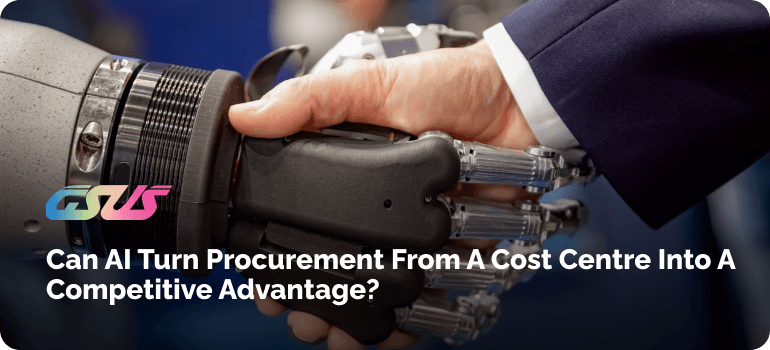
For years, procurement has been treated as the department that exists to keep spending down.
Get the best price, negotiate hard, close the deal, move on. That mindset worked fine when supply chains were predictable. It doesn't work so well anymore.
Between rising raw material costs, unreliable suppliers, and demand patterns that change faster than anyone can forecast on a spreadsheet; procurement teams are being asked to do more with less time and less certainty.
That's exactly why AI in procurement has become such a hot topic, not because it's trendy, but because purchasing decisions now need data and speed that manual processes simply can't deliver.
This raises the real question: can intelligent procurement actually become a competitive advantage, or is it just another buzzword? Let's dig in, including where AI falls short without the right foundation underneath it.
Why Traditional Procurement Is Struggling in a Data-Driven Business Environment
Manual Purchase Processes Create Hidden Procurement Costs
Every manual purchase requisition, every email chain chasing a supplier quote, every purchase order typed up by hand, all-cost time, and time costs money.
Most businesses never actually calculate what manual procurement processes are costing them in labour hours, delayed approvals, and duplicate orders. It adds quietly, which is exactly why it's rarely questioned.
Spreadsheet-Based Procurement Limits Real-Time Visibility
Spreadsheets are great for a lot of things. Running live procurement decisions isn't one of them. By the time a spend report gets compiled and circulated, the numbers are already out of date.
Real-time visibility isn't possible when your source of truth is a file someone updates once a week.
Disconnected Procurement and Inventory Data Delays Decisions
If your purchasing team can't see live inventory levels, they're either buying too early (tying up cash in stock nobody needs yet) or too late (scrambling to expedite orders when a shortage hits).
This is one of the most common and most avoidable problems in procurement today.
Supplier Risk Is Harder to Manage Without Centralised Data
When supplier information, past performance, pricing history and delivery records are scattered across different systems or people's inboxes, it becomes genuinely hard to spot a risky supplier before it becomes a problem.
Supplier management shouldn't rely on someone's memory of "how that vendor was last time."
What Is AI Procurement and How Is It Changing Purchasing Decisions?
AI procurement means using machine learning and data analysis to make buying decisions, instead of just manual judgment and static reports. It doesn’t replace the buyer. It provides the buyer with better information, faster.
How Artificial Intelligence Is Used in Procurement
AI is used to analyse historical spend, flag anomalies, predict future requirements, assess supplier risk, and even automate repetitive tasks like generating purchase orders once certain conditions are met.
AI-Powered Spend Analysis and Procurement Forecasting
Instead of manually digging through invoices to understand where money is going, AI-driven spend analysis can categorise spend automatically and highlight patterns, like which categories are creeping up in cost, or which suppliers are quietly becoming too dominant in your buying.
AI for Supplier Selection and Supplier Risk Management
AI can score suppliers based on delivery reliability, pricing consistency, and quality history, making supplier risk assessment far more objective than gut feeling.
Predictive Procurement for Demand and Inventory Planning
By looking at sales trends, seasonality, and production schedules, predictive procurement tools can estimate what you'll need to buy, and when, before a shortage or overstock situation even shows up.
AI-Powered Purchase Order Automation
Routine reordering, based on reorder points or predicted demand, can be automated, so buyers spend their time on strategic sourcing instead of chasing routine paperwork.
From Procurement Automation to Procurement Intelligence
There's a natural progression happening across procurement teams: Manual Procurement → Automated Procurement → Intelligent Procurement.
Automation Reduces Repetitive Procurement Tasks
Automation handles the repetitive stuff, approvals, PO generation, reminders, freeing people from admin to work.
Analytics Turns Procurement Data into Actionable Insights
Once data is flowing properly, analytics turns raw numbers into insights procurement teams can act on, rather than just report on.
AI Helps Procurement Teams Make Predictive Decisions
This is where procurement analytics becomes genuinely predictive, flagging a supplier at risk before a late delivery happens, or forecasting a stock shortfall week in advance.
Why Procurement Intelligence Matters for Business Growth
Procurement intelligence isn't just about saving money. It's about making purchasing decisions that support business growth, buying at the right time, from the right supplier, at the right cost, without slowing production down.
Why AI Alone Cannot Fix a Broken Procurement Process
Here's the part most articles about AI conveniently skip: AI is only as good as the data feeding it. If your procurement data is scattered, outdated, or disconnected from the rest of the business, no algorithm can fix that.
AI Needs Reliable Procurement and Supplier Data
Garbage in, garbage out still applies. AI models need clean, structured, and current procurement and supplier data to produce anything useful.
Why Data Silos Limit AI-Powered Procurement
If sales data live in one system, inventory in another, and procurement in a spreadsheet, AI has nothing coherent to work with. Data silos are the single biggest blocker to AI-powered procurement actually working in practice.
Connecting Procurement with Inventory, Sales and Manufacturing
Procurement decisions don't happen in isolation. They depend on what's selling, what's in stock, and what production needs next. Without that connection, AI predictions are guessed as insights.
Why ERP Is Becoming the Foundation for Intelligent Procurement
This is exactly why ERP for procurement management has become so important. An ERP system for procurement automation gives AI a single, connected source of business data to work with, instead of trying to make sense of disconnected spreadsheets.
How Odoo ERP Connects Procurement with the Rest of the Business
This is where Odoo procurement comes into the picture, not as a magic fix, but as the connected foundation that intelligent procurement actually needs.
Odoo Purchase & Supplier Management
Odoo Purchase gives you RFQs, purchase orders, vendor management, purchase agreements and supplier information all in one place, replacing scattered emails and spreadsheets with a single source of truth.
Connect Procurement with Odoo Inventory Management
Odoo procurement’s tight integration with inventory means buyers can keep an eye on livestock levels, incoming shipments and replenishment needs without having to switch systems or rely on someone else’s report
Connecting Procurement with Odoo Manufacturing
For manufacturers, Odoo procurement management ties directly into manufacturing orders and BOMs, so material requirements and raw material availability are visible before a production delay happens, not after.
Connecting Procurement with Sales and Finance
Sales demand flows into purchasing requirements, and purchase orders flow into vendor's bills and accounting, giving finance and procurement the same numbers, at the same time, without reconciliation headaches.
How AI and Odoo ERP Can Make Procurement More Predictive
When AI sits on top of connected ERP data, procurement stops being reactive.
- Predicting procurement requirements becomes possible when sales, inventory, and production data all live in one system.
- Using inventory data this way helps prevent both stockouts and overstocking, instead of guessing safety of stock levels.
- Identifying supplier performance and risk patterns becomes far easier when every purchase order and delivery is logged consistently.
- Automating routine procurement workflows, approvals, reorders, reminders, free procurement teams for actual sourcing strategy.
Most importantly, teams finally get real-time visibility into what's happening, instead of last week's snapshot.
Can AI Reduce Procurement Costs Without Sacrificing Business Agility?
This is really the heart of the "cost center versus competitive advantage" question.
- Reducing administrative procurement costs happens naturally once repetitive tasks are automated.
- Controlling maverick spending becomes easier when purchases outside approved channels are flagged automatically.
- Improving supplier negotiation gets a lot stronger when you're walking into a conversation with real spend and performance data, not assumptions.
- Reducing excess inventory and material waste follows directly from better demand forecasting.
- Improving procurement cycle times means fewer bottlenecks between requisition and delivery.
None of this requires sacrificing agility. If anything, connected data and automation make a procurement team faster to respond, not slower.
What Does Intelligent Procurement Look Like in a Manufacturing Business?
Before AI-enabled procurement: Sales, production, inventory and purchasing all operate in their own bubbles. Sales books an order, production finds out late, inventory doesn't know what's coming and purchasing scrambles to source raw materials under time pressure, often paying a premium for rush delivery.
After connecting ERP and intelligent procurement: Customer demand flows into a sales forecast, which feeds production planning, which calculates material requirements. That's checked against inventory availability, which automatically generates a procurement requirement.
The system suggests the right supplier based on past performance, a purchase order goes out, and production isn't left waiting. That's what a manufacturing procurement software setup, backed by AI and a connected ERP, is meant to be achieved.
AI Procurement vs Traditional Procurement: What Actually Changes?
| Traditional Procurement | AI-Enabled Procurement |
|---|---|
| Manual purchase planning | Data-driven planning |
| Spreadsheet-based analysis | Automated analytics |
| Reactive buying | Predictive purchasing |
| Limited supplier visibility | Supplier intelligence |
| Manual approvals | Automated workflows |
| Separate business data | Connected ERP data |
| Historical decisions | Predictive insights |
What Businesses Should Consider Before Adopting AI-Powered Procurement
Before jumping into AI-powered procurement, ask a few honest questions: Is your procurement data clean and reliable? Are your business systems properly connected, or still siloed? Which processes genuinely need automating first? And where does standard ERP functionality already solve the problem, without custom development? Change management matters too; employees need to understand why workflows are shifting; not just be told they are.
How to Build an AI-Ready Procurement Process with Odoo ERP
Getting ready for intelligent procurement doesn't happen overnight. A practical path usually looks like this:
- Map existing procurement processes to understand where the actual bottlenecks are.
- Connect procurement with business operations, inventory, manufacturing, sales, finance.
- Clean and centralise procurement data so it's usable, not just stored.
- Automate repetitive procurement workflows first, before layering on analytics.
- Introduce analytics and AI capabilities once the data foundation is solid.
- Measure procurement performance regularly to see what is actually improving.
This is where an experienced Odoo implementation partner can help translate existing procurement processes into a properly connected ERP environment, rather than bolting AI onto a broken system and hoping for the best.
The Future of Procurement: From Cost Control to Competitive Advantage
Procurement technology is moving fast - AI-assisted decision-making. Predictive procurement, supplier intelligence, and real-time data are no longer nice-to-have for large enterprises only. They're becoming standard expectations.
So, can procurement move from the cost centre to a competitive advantage? Yes, when it helps businesses buy smarter, respond faster, and catch problems before they ever reach the production floor.
Final Takeaway - AI Is Only as Powerful as the Business Data Behind It
AI provides intelligence. ERP provides connected data. Automation provides speed. Procurement teams provide judgement.
Put together, these four things can genuinely transform procurement from a cost-control function into a strategic business capability.
As a Silver Partner with Odoo, GSUS works with manufacturing and distribution businesses to build exactly this kind of connected procurement foundation, one that's actually ready for AI, not just claiming to be.
Want to know whether your procurement process is ready for Odoo and AI-driven automation?
Talk to GSUS about your current procurement workflow and identify where automation and connected ERP data can create measurable improvements.