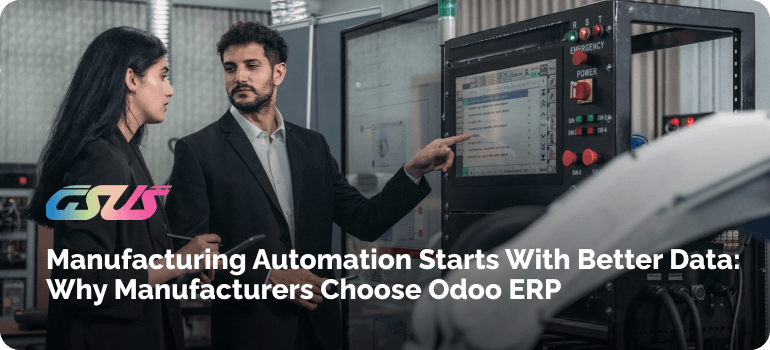
Walk into any manufacturing plant today and you'll hear the same conversation in the boardroom. Everyone wants manufacturing automation, robots on the line, AI-driven forecasting, and IoT sensors reporting machine health in real time.
It's obviously the next step to staying competitive. Yet so many of these projects quietly stall out within a year or two, leaving expensive equipment underused and management scratching their heads.
Here's the part nobody likes to admit: the problem usually isn't the technology. It's the data feeding it.
Manufacturers pour money into smart machines while running production schedules off three different spreadsheets, disconnected inventory systems, and purchase orders living in someone's inbox.
You can bolt AI onto a broken process, but it won't fix the process; it'll just make the mess move faster.
This is exactly where Odoo ERP earns its reputation. Instead of treating automation as a bunch of separate gadgets, Odoo builds one connected system.
A single source of truth, where sales, inventory, purchasing, and the shop floor all talk to each other. That's the real starting point for automation that sticks.
What Is Manufacturing Automation and Why Is It Important for Modern Manufacturers?
Manufacturing automation is not just a fancy word for robotic arms welding car frames. At its core, it's about using technology and interconnected systems to cut down on manual, repetitive work throughout the production chain. Involves planning, procurement, quality checks, inventory and reporting
Understanding Manufacturing Automation Beyond Robotics
People picture robots when they hear "automation," but the biggest wins often come from far less glamorous places. Auto-generating purchase orders when stock hits a reorder point. Triggering a work order now, a sales order is confirmed.
Updating inventory counts when the second barcode is scanned. None of that requires a single robot, just a system that connects the dots automatically.
Why Manufacturers Are Accelerating Digital Transformation
Rising labour costs, tighter margins, and customers expecting faster delivery windows are pushing manufacturers toward Digital Transformation whether they're ready or not.
Add global supply chain disruptions into the mix, and smart factory investment has become less of a "nice to have" and more of a survival strategy.
Common Goals of Manufacturing Automation
Most manufacturers chasing automation want the same handful of outcomes: fewer manual errors, faster production cycles, better visibility into what's happening on the floor, and the ability to scale up without hiring an army of people to manage spreadsheets. Simple goals, but surprisingly hard to hit without the right foundation.
Why Better Data Is the Foundation of Successful Manufacturing Automation
Why Automation Is Only as Good as the Data Behind It
Here's a truth that gets ignored way too often: an automated system built on bad data just automates the bad data faster. If your inventory numbers are wrong, an AI-powered demand forecast will confidently give you the wrong answer.
Manufacturing automation with ERP works precisely because it fixes the data problem before layering automation on top of it.
How Disconnected Systems Create Operational Blind Spots
When sales use one tool, the warehouse uses another, and accounting is still working off Excel; nobody has the full picture. Orders are missing. Stock gets double-booked.
Production planners find out about a shortage only after the machine is idle. That's connected manufacturing data working against you instead of for you.
The Cost of Poor Data Quality in Manufacturing
Poor data is a direct hit to the bottom line. Late shipments, overstocked warehouses sitting next to stockouts on other SKUs, quality issues that go unnoticed until a customer complains.
Manufacturing data management done properly prevents most of this before it becomes a customer-facing problem.
The Biggest Data Challenges That Prevent Manufacturing Automation
Spreadsheet Dependency
It's almost a cliché at this point, but spreadsheets are still running huge parts of manufacturing operations worldwide.
They're flexible, sure, but they're also disconnected from everything else, easy to break with one wrong formula, and impossible to keep in sync across departments in real time.
Duplicate Data Across Departments
Sales enter a customer order in one system. Production re-enters the same details in another. Somewhere along the way, a quantity gets typed wrong, and now there's a mismatch nobody notices until the shipment goes out short.
Manual Inventory Updates
If someone has to physically count stock and type numbers into a system by hand, errors are guaranteed. It's not a question of if, but when.
Delayed Production Visibility
By the time a production manager finds a work order is behind schedule, it's often already too late to course-correct without missing a delivery date.
Lack of Real-Time Reporting
Monthly or weekly reports feel outdated the moment they're printed. Manufacturing automation challenges almost always trace back to this; decisions being made on data that's already stale.
How Odoo ERP Helps Manufacturers Build a Data-Driven Manufacturing Environment
Centralising Production, Inventory and Procurement Data
Odoo ERP for manufacturing pulls production, inventory, and procurement into one place. No more toggling between five tools to figure out whether you have enough raw material to fulfil an order; it's all sitting in the same dashboard.
Connecting Sales, Purchasing and Manufacturing
When a sales order comes in, Odoo can automatically check stock, trigger a manufacturing order if need, and even generate a purchase request for missing components, all without a human manually chasing each step.
Real-Time Shop Floor Visibility
Operators can update work order status directly from a tablet or barcode scanner on the floor, so the office knows exactly where production stands, not where it stood yesterday.
Automated Workflows Across Departments
Business process automation in Odoo isn't limited to production. Approvals, notifications, and follow-up tasks move between departments automatically, cutting down the back-and-forth emails that slow everything down.
Single Source of Truth for Better Decision-Making
Maybe the biggest advantage: everyone, from the warehouse supervisor to the finance director, is looking at the same numbers. No more arguing over whose spreadsheet is correct.
Key Odoo ERP Features That Support Manufacturing Automation
Odoo manufacturing modules cover a lot of ground, and all contribute to building a truly automated operation:
- Manufacturing (MRP) – Manages bills of materials, work orders and scheduling in a single connected flow.
- Inventory Management – Real-time stock level tracking and automated reorder rules.
- Purchase Management – Automatically creates quotations and purchase orders based on actual demand.
- Quality Management – Incorporates quality checks into production rather than afterthought.
- Maintenance – Schedules preventive maintenance to prevent a breakdown that would halt the line.
- PLM (Product Lifecycle Management) – synchronizes engineering changes and production data.
- Barcode Operations – Speeds up inventory counts and cuts down on manual entry errors.
- IoT Integration - Integrate shop floor machines with Odoo for live status updates.
- AI Features in Odoo – Helps with demand forecasting & smarter scheduling, built on data accuracy.
- Reporting & Dashboards – Gives each department manufacturing data in real-time, not a monthly export that no one reads in time.
How Odoo ERP Powers Manufacturing Automation Across Every Department
End-to-end Manufacturing Automation only works if every department is in the same system, not working in isolated pockets.
- Sales Automation – Quotes and delivery scheduling flow without the need to re-enter.
- Procurement Automation – Purchase requests are generated by reorder points before materials run out.
- Automation of production planning – orders are scheduled according to real capacity and material availability, not guesswork.
- Inventory Automation - Stock levels are updated with every movement, scan or production output.
- Warehouse Automation – How-to-guide for picking, packing and put-away workflows.
- Quality Control Automation – Issues are caught early by checkpoints at set stages.
- Maintenance Automation - Unplanned downtime reduced by preventive schedules.
- Accounting Automation - As production and sales activity occurs, invoicing and costing are automatically updated.
Business Benefits of Manufacturing Automation with Odoo ERP
Once the system is rightly implemented, the advantages of Odoo ERP become quite apparent:
- Faster Production Planning – Schedules are based on real data, not guesses.
- Better Inventory Accuracy – Stock counts finally match what’s on the shelf.
- Less Manual Work – Teams spend less time on manual data input and more time solving problems.
- Lower Operational Costs – Savings come from fewer errors and less overstocking.
- Faster customer deliveries – No longer waiting on manual approvals – orders flow through the system.
- Improved Production Transparency – Everyone can see what’s happening on the floor in real time.
- More Informed Decisions – Managers have up-to-date numbers, not last month’s report.
- Enhanced Productivity – Less time firefighting data issues translates into more time building products.
Manufacturing automation ROI isn't instant, but manufacturers who commit to the process usually see measurable gains within the first two to three quarters of going live.
Why Manufacturers Choose Odoo ERP Over Disconnected Systems
One Integrated Platform
Instead of stitching together separate tools for accounting, inventory, and production, Odoo brings it all under one roof, which is exactly why so many manufacturers move away from patchwork systems.
Scalable for Growing Manufacturers
Whether you're running one facility or planning to expand into three more over the next few years, Odoo scales with you instead of forcing a system of migration every time you grow.
Flexible Customization
Every manufacturing operation has quirks; Odoo's modular structure allows configuration around real workflows instead of forcing a rigid, one-size-fits-all process on the business.
Affordable Compared to Traditional ERP
Traditional ERP for manufacturing companies often comes with licensing costs that scale badly as headcount grows.
Odoo's pricing model tends to be far more predictable, which matters a lot for mid-sized manufacturers watching their budgets closely.
Open-Source Ecosystem
Because Odoo is built on an open-source foundation, there's a huge global community and app ecosystem constantly extending what the platform can do, without locking manufacturers into a single vendor roadmap.
If you're evaluating vendors for an Odoo ERP for manufacturing project, it's worth working with a partner who understands manufacturing workflows, not just generic ERP setup.
As a Silver Partner with Odoo, GSUS has worked closely with manufacturers going through exactly this kind of transition, connecting shop floor data, procurement, and reporting into one coherent system rather than another disconnected tool bolted onto old habits.
That kind of hands-on implementation experience tends to make the difference between an ERP rollout that gets used and one that quietly gets abandoned six months in.
Is Your Manufacturing Business Ready for Automation?
Manufacturing automation readiness usually comes down to a handful of warning signs. If several of this sound familiar, it's probably time to look seriously at your systems:
- Multiple spreadsheets across departments that never quite match up
- Manual production planning based on guesswork or tribal knowledge
- Inventory inaccuracies that cause stockouts or overordering
- Delayed reporting that arrives too late to act on
- Frequent communication gaps between sales, purchasing, and the floor
- Limited visibility into what's happening in real time
If that list feels a little too accurate, your manufacturing digital transformation probably shouldn't start with buying new machines.
It should start with fixing the data foundation that machines will eventually run on. ERP implementation for manufacturers is rarely glamorous at work, but it's the groundwork that makes every automation investment afterward actually pay off.
Conclusion
Manufacturing automation isn't just about robots, AI, or IoT sensors blinking away on the factory floor. It starts with something far less flashy, connected, accurate, real-time business data.
Without that foundation, even the most advanced smart factory technology ends up automating chaos instead of eliminating it.
Odoo ERP gives manufacturers the integrated foundation they need, one place where production, inventory, procurement, and reporting finally speak the same language.
That's what turns Manufacturing Automation from an expensive experiment into a genuine competitive advantage, and it's exactly the kind of transformation GSUS, as an Odoo Silver Partner, helps manufacturers build from the ground up.