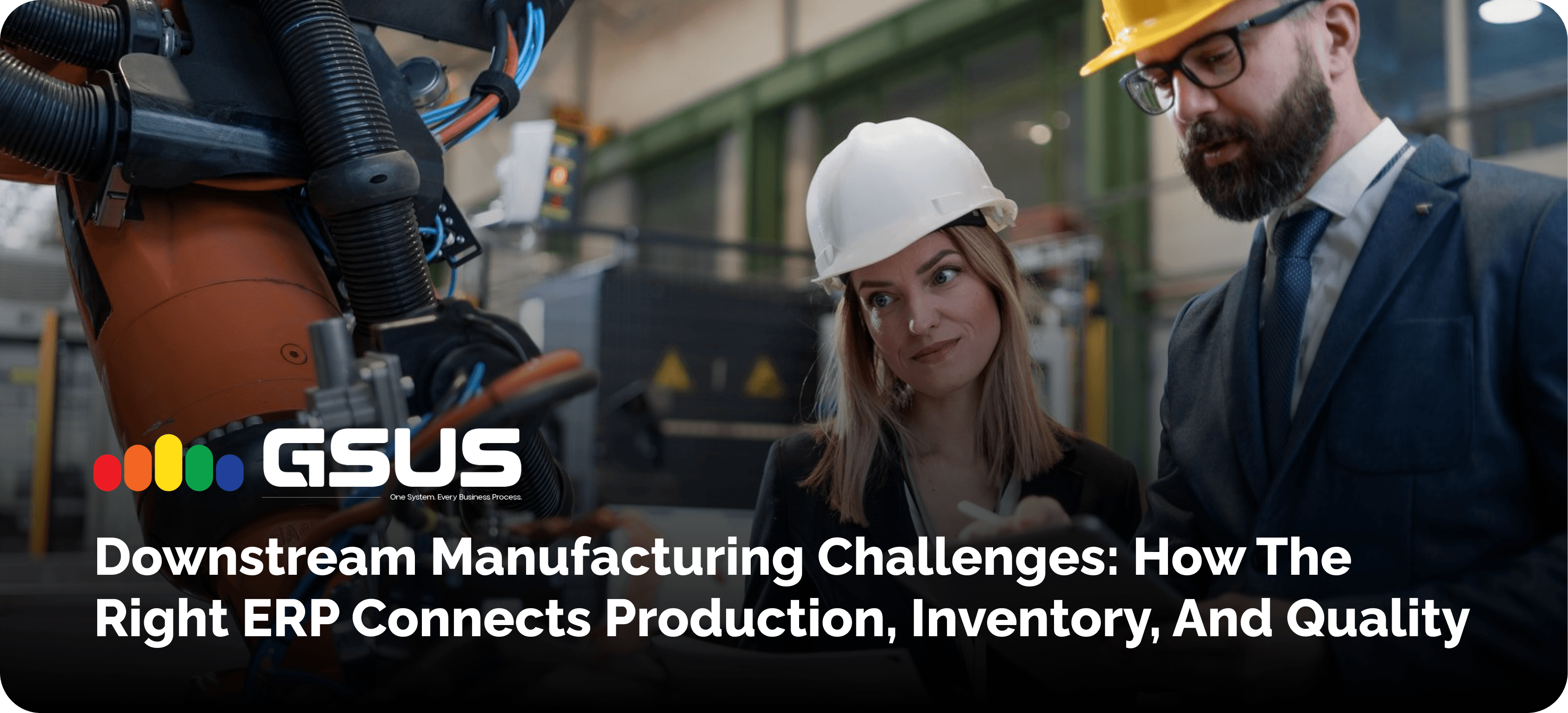
Ask a plant manager what keeps them up at night, and it's rarely one big thing. It's the small stuff stacking up: a batch waiting on material the system says is in stock; a quality holds the planner never heard about, a customer order that slips two days because the schedule lived in someone's spreadsheet.
That's everyday life in downstream manufacturing. Material moves through processing, blending, assembly, packing, and dispatch, and every step depends on the one before it. With ten orders a week, people can hold it all in their heads. At a hundred, they can't.
Most downstream manufacturing challenges, such as production delays, inventory mismatches, inconsistent quality, and teams working from different numbers, trace back to one root cause: production, inventory, and quality live in separate systems.
A Downstream manufacturing ERP closes those gaps by putting all three on one set of data. In this guide, we'll look at where things break, how an ERP fixes them, and what to check before you choose one. We'll also show how Odoo handles it, since Odoo implementation is what we do at GSUS.
What Are the Biggest Challenges in Downstream Manufacturing?
Poor Production Planning and Scheduling
Plans made on a whiteboard or in Excel go stale at lunchtime. A job starts before the material shows up; one machine is overloaded while its neighbour sits idle, and nobody can say which work orders are running late without walking on the floor.
One slipped job pushes back everything behind it. That's the quiet cost of weak production scheduling.
Inventory Inaccuracy and Raw Material Tracking Problems
The register says 500 kg. The shelf says 380. Usually it's nothing dramatic, just a transfer logged late or a consumption nobody entered. But the gap shows mid-run, which is the worst possible time. Poor raw material tracking cuts the other way too: over-ordering ties up cash and leaves you with material expiring in a corner of the store.
Quality Control Issues and Inconsistent Standards
When inspections happen late, or the results sit on paper, a defect travels further than it should. Then someone asks the painful question: which batches are affected? Without clean records, the safe answer is "all of them", and that means a lot of avoidable reworks.
Weak Coordination Between Production, Inventory, and Quality Teams
Every team keeps its own file, and every file tells a slightly different story. Updates travel over phone calls and WhatsApp messages. At month end, somebody spends two days reconciling it all.
Limited Visibility and Slow Decisions
If you find out about a bottleneck after the shift ends, you can explain it, but you can't fix it. Without real-time production monitoring, managers fall back on end-of-day reports and instinct, and instinct is only right so often.
Why Traditional Systems Can't Keep Up with Growing Operations
Spreadsheets are great, right up until they aren't. The trouble starts when accounts run in one tool, stores in another, and production in a third. Every handoff means typing the same data again, and every re-entry is another chance for a mistake.
Scaling hurts, too. In a disconnected setup, more customers or more product lines mean more people just to keep the data in sync.
That's growth in the wrong direction. Manufacturing process automation only pays off when the data underneath is shared, otherwise you're just automating the inconsistency.
That's where manufacturing ERP software earns its keep, and why a downstream manufacturing ERP usually beats yet another standalone tool.
How Does a Downstream Manufacturing ERP Connect Production, Inventory, and Quality?
The idea is simple: one record, shared by everybody. When a planner confirms an order, stores, quality, and purchasing, see it at the same time.
That shared record is the whole point of a downstream manufacturing ERP, and it shows up in five places.
Production Planning Tied to Live Inventory
Before a manufacturing order is confirmed, the system checks whether the components on the bill of materials (BOM) are actually available. If something's short, it tells you early or raises a purchase request. This one habit prevents a surprising number of mid-run stoppages.
Inventory That Updates Itself
Raw materials, work-in-progress, and finished goods are tracked as they move. Material consumed on the line comes off stock automatically, so nobody must remember to log it later. Transfers between the warehouse and the production floor stay on record, which makes inventory control far less of a guessing game.
Quality Checks at Every Stage
Inspections can sit at incoming receipt, during production, and before dispatching. Rejections and corrective actions attach to the actual batch, not to a notebook on someone's desk. That's what a proper quality management system looks like when it isn't an afterthought.
Batch Tracking and Material Traceability
With lot or serial numbers captured from receipt to delivery, you can trace a finished product back to its raw material, or forward to every customer who received a suspect batch. When something goes wrong, you isolate it instead of guessing.
Dashboards That Show What's Happening Now
Progress, consumption, rejections, and bottlenecks in one view, so decisions get made on today's numbers. It's the main reason ERP for production and inventory management has become the usual route for growing manufacturers.
How Odoo ERP Helps Downstream Manufacturers Manage Their Entire Production Process
Odoo is modular, so you can start with what you need and add the rest later. One note on editions: some apps and features, like Quality and parts of the shop floor experience, are part of Odoo Enterprise, so it's worth confirming early what your setup needs.
Odoo Manufacturing. Create manufacturing orders, set up multi-level BOMs, assign work orders to work centres, and follow progress from the shop floor. Work order management stays linked to stock and purchasing, so nobody copies numbers across by hand.
Odoo Inventory. Raw materials, semi-finished goods, and finished products across multiple warehouses, with reordering rules that catch a stockout before your production line does.
Odoo Quality. Quality control points at receipt, in production, or before shipping. Alerts and non-conformances are logged against the product or lot involved.
Odoo Maintenance. Preventive maintenance schedules, breakdown logs, and maintenance requests. Fewer surprise stoppages mean a production schedule you can trust.
Odoo Purchase. Vendors, purchase orders, and incoming deliveries, tied to what stock really needs instead of gut feel.
Odoo Reporting. Production costs, material consumption, wastage, work centre efficiency, and inventory valuation, without exporting everything to Excel first.
None of these works by magic. Odoo gives you the tools, but how well they fit depends on how your processes are mapped and configured. Set up properly, it behaves like a downstream manufacturing ERP that follows your floor, rather than forcing your floor to follow it. The Odoo Manufacturing module is one piece of that larger, connected setup.
How to Choose the Right ERP for Downstream Manufacturing Businesses
Whatever you're evaluating, put these questions to the vendor:
- Planning: Can it handle your real production planning and scheduling, not just the demo?
- Inventory: Does it fit your warehouse layout, units of measure, and stock rules?
- Quality: Is quality control built in, or a separate add-on you'll stitch together yourself?
- Traceability: Lot and batch traceability, backward and forward.
- Reporting: Can managers see live performances without raising an IT ticket?
- Flexibility: How easily can it be customized and connected to the tools you already run?
- Support: What do implementation, training, and long-term support look like in practice?
That last one gets underestimated. People compare feature lists, but the way a system is set up and supported usually decides whether anyone uses it.
We'd take a plainer downstream manufacturing ERP that's configured well over a feature-packed one that's configured badly, every time.
If you're shortlisting manufacturing ERP software, ask each vendor to walk through one of your real jobs, from raw material receipt to dispatch, and watch what happens. It's also the quickest way to judge ERP for production and inventory management in practice.
What to Consider Before Implementing Odoo ERP
A few things separate a smooth go-live from a painful one:
- Understand your current workflows before you touch any software.
- Map production, inventory, and quality processes end to end, including the workarounds people use today.
- List integration and customization needs. Some are essential; others can wait.
- Clean your data. Migrating duplicate items or wrong BOMs only moves the mess into a new system.
- Train every department, not just the project champion.
- Test real workflows before going live.
- Plan support for afterwards. The first few weeks always throw up small adjustments.
Skip the mapping step and you'll end up customizing around problems a small process change would have fixed. Good ERP customization for manufacturing starts with knowing what truly needs to be customized. That's true of any Odoo ERP implementation: the software is the easy part. Planning an ERP for downstream manufacturing is mostly about understanding the floor first.
Why You Need an Implementation Partner Who Understands Manufacturing Processes
Installing software is the easy part. Making it match how your plant really runs is where the work is. A partner who only knows the product will configure what's on the menu.
A partner who understands the process asks why your quality check sits where it does, or why that one material always runs short. A downstream manufacturing ERP is only as good as the people who set it up.
That's the approach we take at GSUS. We don't start with the software. We first understand how your manufacturing operations work, identify the gaps, and configure an ERP system around your actual business processes.
As an Odoo Silver Partner, we handle implementation, customization, integration with your existing systems, data migration, and ongoing support.
For ERP for downstream manufacturing, that continuity matters: the team that learns about your process is the one that stays after go-live.
Build a Connected Downstream Manufacturing Operation with Odoo ERP
Disconnected production, inventory, and quality cost delay, rework, stock errors, and hours spent chasing information.
Patching one symptom at a time rarely sticks, because the downstream manufacturing challenges all come from the same place: data that doesn't flow.
A well-implemented downstream manufacturing ERP puts everyone on the same page, literally. Planning sees stock, stock sees production, quality sees both, and managers see all of it.
Odoo is a strong way to build that connection, especially when it's set up around your real workflows.
Ready to Connect Your Production, Inventory, and Quality Operations?
Discuss how GSUS can help assess your manufacturing workflows and implement an Odoo ERP solution that fits your business. Reach out to our team and we'll start with a conversation about how your plant runs today.