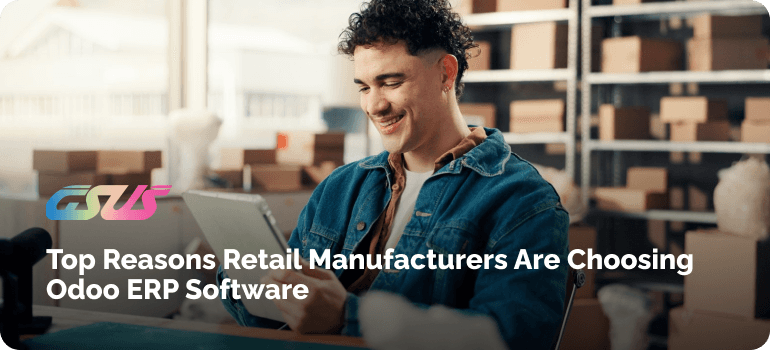
Running a retail manufacturing business is messy. Not in a bad way, just in the way that comes with doing a lot of things at once.
You’re sourcing raw materials, keeping the production floor moving, managing warehouse stock, pushing orders out the door, and somehow trying to keep customers happy through all of it.
And most businesses we’ve worked with? They’re doing all of this across a patchwork of tools. One spreadsheet for inventory. Another for purchase orders.
Accounting software that doesn’t talk to the warehouse. A sales team logging deals in one place while operations work from a completely different system.
It works. Until it doesn’t.
That’s the thing about manual, disconnected processes; they hold up right until the moment they collapse. A missed reorder. A shipment going out with incorrect stock numbers.
Finance is running month-end on data that’s already two weeks stale. These aren’t hypothetical disasters. They happen.
Which is exactly why so many Retail Manufacturing Business have been making the shift to Odoo ERP.
What Actually Is Odoo ERP?
If you haven’t come across it before, Odoo ERP is an open-source business management platform.
But that description doesn’t really do it justice. It’s more like a full operational backbone, sales, inventory, procurement, manufacturing, accounting, customer management, all built to work together inside one system.
What makes it different from the traditional ERP software most people have heard (or lived) horror stories about is the way it’s structured. You don’t buy one enormous, take-it-or-leave-it package.
You pick up the modules that are relevant to your business right now and build them from there. A retail manufacturer might start with Inventory, Sales, and Purchase, then layer in Manufacturing ERP tools and accounting a few months later when they’re ready.
It’s flexible in a way that older ERP enterprise systems simply aren’t. And for businesses that have been burned by clunky legacy software before, that matters a lot.
Why the Old Way Stops Working (And When)
Here’s what we see again. A Retail Manufacturing Business grows, maybe faster than expected, and the processes that worked at a smaller scale start showing cracks.
The inventory team is doing daily stock counts because the system numbers can’t be trusted. The sales team is promising delivery timelines that the warehouse can’t meet because no one checks availability in real time.
Finance is spending half their week chasing numbers from different departments instead of actually analysing them.
None of this is anyone’s fault. It’s just what happens when a business outgrows its tools.
The real cost isn’t wasted in time, though that’s significant. It’s in the decisions made on bad information. Overstocking products that don’t move.
Understocking the ones that do. Suppliers are not getting paid on time because purchasing data lives in someone’s email inbox. These things add up quietly, and they add up fast.
What Odoo ERP Software Actually Changes Day-to-Day
Let’s get specific, because “centralised visibility” and “streamlined operations” sound great on a product page but don’t tell you much about what changes when you go live.
- The inventory picture becomes real. Not the end-of-day real. Not “someone updated the spreadsheet this morning” real. Live, accurate, and visible to everyone who needs it. Stock movements, reservations, incoming purchase orders, what’s committed to outgoing sales, all of them in one place. For retail manufacturers handling both raw materials and finished goods, this is genuinely transformative.
- Orders stop getting lost in the handoff. From the moment a customer places an order, through your website, your point of sale, or a direct B2B channel, Odoo ERP moves it through a defined workflow. Picking, packing, dispatching, and invoicing. Each step gets done, gets logged, and gets visible to the next person in the chain. No more “I thought you were handling that.”
- Procurement basically runs itself. You set up reorder points, and when stock drops below them, the Odoo ERP System raises purchase orders automatically. Your procurement team goes from manually tracking what needs ordering to review and approving orders the system has already drafted. That’s a significant shift in how they spend their time.
- Finance closes faster. When your accounting module is connected to your sales, inventory, and purchasing data, not synced nightly, connected, your books reflect reality as it happens. Month-end closes that used to take a week to start taking a day.
Why Retail Manufacturers Are Picking Odoo Over Older Systems
The Traditional ERP Software market has a reputation problem. Massive upfront costs, year-long implementations, consultants charging the hour for every small change, and systems so rigid that adapting them to your actual business is a project.
Odoo ERP Software doesn’t fit that mould.
It’s open source at its core, which means no licensing fees eating into your budget before you’ve seen a single result. Implementations move faster, realistically three to six months for a well-scoped retail manufacturing deployment, compared to twelve to eighteen months for older ERP enterprise systems.
The eCommerce and Point of Sale integrations are native. If you’re selling directly to consumers alongside your wholesale business, which more retail manufacturers are doing, Odoo connects those channels to your back-office without needing custom connectors or middleware.
A sale at your retail counter updates inventory immediately. An online order feeds into the same fulfilment workflow as a B2B order.
That kind of connected operation used to require multiple systems and a dedicated IT team to maintain the integrations. Now it’s just how the Odoo ERP system works out of the box.
Key Features That Actually Matter for Retail Manufacturers
Rather than listing every module on the platform, here are the ones retail manufacturing businesses use most, and why:
- Inventory and warehouse management - multi-warehouse support, lot and serial number tracking, put-away rules, barcode scanning, and stock valuation including FIFO and average cost. Handles both production inputs and retail-ready finished goods.
- Manufacturing ERP tools - Bills of materials, work orders, production scheduling, quality checkpoints. Supports make-to-stock and make-to-order workflows, which matters if your mix includes standard items alongside custom orders.
- Point of Sale - Works offline, syncs back when reconnected. Every transaction feeds directly into inventory and accounting. No end-of-day reconciliation of headaches.
- Automated procurement - Reorder rules, vendor price lists, lead time tracking. The goal is for your team to review orders rather than generating them from scratch.
- CRM and customer management - Linking customer history to orders and invoices gives your team context when handling queries or managing repeat clients.
What a Real Deployment Looks Like
Take an apparel manufacturer we worked with, selling to retail chains on one side, running their own brand stores on the other.
Before Odoo ERP, they were reconciling stock between their warehouse and online store every single morning. It took two people about an hour each day.
Returns from stores took three to four days to show back up in available inventory. Finance was working from data at least ten days old.
After the Odoo implementation, stock reconciliation became automatic. Returns processed in real time. Finance cut their month-end close from eight days to three.
A food manufacturer we supported had different challenges, batch traceability for compliance, seasonal production planning, and complex invoicing requirements from supermarket clients.
Odoo brought compliance tracking, production scheduling, and customer-specific invoicing into one system. Their compliance reporting went from a manual quarterly exercise to something they could pull in twenty minutes.
These are the kinds of changes that show business results. Not in demos.
As a certified Odoo Silver Partner, GSUS has worked through Odoo Implementations across different retail manufacturing contexts. We don’t offer a one-size-fits-all setup; we look at your actual processes and figure out what will make the most immediate difference. If you want a real conversation about what Odoo ERP could look like for your operation, reach out to us.
How to Get Implementation Right
The biggest thing to understand about implementing any ERP system is that the technology is not the hard part. The hard part is everything around it.
- Know what you’re starting with. Document your actual processes before you configure anything. Not the ideal version, how things actually work today. The gaps between those two pictures are where you make your configuration decisions.
- Don’t try to go live with everything at once. Pick the modules with the biggest immediate impact, go live with those, then build outward. Phased implementations consistently outperform big-bang go-lives.
- Take training seriously. Every Odoo implementation that underdelivers has the same story: correctly configured, but the team didn’t know how to use it. Budget real, workflow-specific training for every team involved.
- Clean your data before you migrate it. Migrating years of messy inventory records into a new system doesn’t fix the mess; it just moves it somewhere new and more expensive to fix.
- Work with someone who’s done this before. The difference between self-implementation and an experienced Odoo Partner isn’t just technical. It’s avoiding decisions that cost money to undo later.
A Few Mistakes Worth Calling Out Directly
Going live with unrealistic expectations. Odoo ERP will improve your operations significantly, but not overnight. There’s a learning curve. Budget for it.
Ignoring the change management side. Some of your team will resist new workflows, especially people who’ve been doing things the same way for years.
That resistance needs to be managed actively, not assumed away.
Over-customising too early. Odoo has enormous built-in flexibility, and most businesses don’t need custom development in the first phase.
Start with what’s there, learn about the system properly, and customise later when you know what you need.
The Future of Retail Manufacturing with Odoo ERP
The retail manufacturing businesses pulling ahead right now are the ones that have their operations connected. Not just automated, connected. Where a procurement decision is visible to production, where a sales order immediately affects inventory, finance always knows what’s happening in the business.
Odoo ERP Software is how you build that kind of operation. It’s not a magic fix and it’s not an overnight project.
But done properly, it’s the kind of investment that changes what a business is capable of, not just how efficiently it runs today.
If your current setup is starting to feel like it’s holding you back rather than keeping up with you, that’s usually the signal. The best time to start was probably last year. The second-best time is now.
GSUS is a certified Odoo Silver Partner with direct implementation experience across retail manufacturing businesses. We help you figure out what the right configuration actually is, not just how to press the buttons. Get in touch if you want to talk about what Odoo ERP could look like for your operation.